The Beijing-Tianjin-Hebei freight train has carried more than 150 million pieces of scattered goods in three years.
From steel to 10 kilograms of miscellaneous grains, the Beijing-Tianjin-Hebei Railway Freight Express provides a new choice of "railway express" with low price and good quality for small and micro enterprises and ordinary citizens along the route.
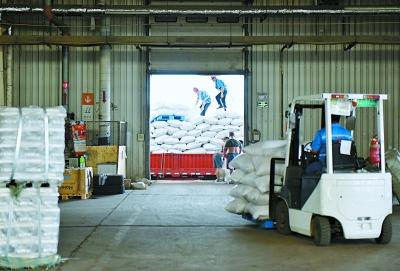
The Beijing Railway Bureau announced yesterday that since the Beijing Railway Bureau took the lead in running the Beijing-Tianjin-Hebei freight express train on July 19, 2014, the number of customers who transported goods through the Beijing-Tianjin-Hebei freight express has reached nearly 60,000 in the past three years, with a total of 4.06 million tons of goods sent to enterprises and individual customers in the region and 158.635 million pieces of scattered express goods sent.
The transportation network covers more than 200 counties and cities.
On July 19th, 2014, the Beijing-Tianjin-Hebei freight express train started, providing "express direct" for short-distance scattered goods and small-batch goods in Beijing-Tianjin-Hebei region, and meeting the flexible and decentralized transportation needs of small and medium-sized enterprises in Beijing-Tianjin-Hebei region. At the same time, this move also aims to alleviate the road traffic congestion in Beijing, Tianjin and Hebei, save energy and reduce emissions, and control environmental pollution.
According to reports, Nancang Station of Beijing Railway Bureau is a scattered freight center station, which has successively opened the North-South Ring Road and the Beijing-Kowloon-Beijing-Tianjin-Hebei express train. The North Ring Express train connects Beijing, Tanggu, Tangshan, Chengde, Zhangjiakou and Langfang. The South Ring Express train will cover Beijing, Langfang, Baoding, Shijiazhuang, Xingtai, Handan, Hengshui, Dezhou, Cangzhou and Tianjin. The Beijing-Kowloon express train connects Yongqing, Bazhou, Renqiu and Hengshui, basically covering more than 200 counties and cities in Beijing, Tianjin and Hebei, and gradually forming a rapid freight network that continues to extend outward.
At the same time, Beijing Railway Bureau has also set up 19 "point-to-point" business stations, that is, through the Beijing-Tianjin-Hebei express station directly sent to the external bureau or the central station of this bureau, to ease the working pressure of the ring line and the Nancang central station, improve the delivery capacity of some express stations and reduce the transportation time of goods.
Up to now, Beijing Railway Bureau has 76 express stations, 185 processing stations and 35 trackless stations, covering more than 200 counties and cities in Beijing, Tianjin and Hebei. There are nearly 60,000 customers who transport goods through Beijing-Tianjin-Hebei freight express.
Individual shippers support more than 60% of the traffic volume.
According to statistics, in the past three years, the volume of express delivery of scattered goods and freight revenue have increased year by year.
In 2014, the Beijing-Tianjin-Hebei freight express sent a total of 9.451 million pieces and 215,000 tons, with an average daily average of 57,000 pieces and 1300 tons; In 2015, the Beijing-Tianjin-Hebei freight express delivered a total of 58.316 million pieces and 1.44 million tons, with an average of 160,000 pieces and 3,900 tons per day; In 2016, the Beijing-Tianjin-Hebei freight express delivered a total of 69.471 million pieces and 1.821 million tons, with an average of 190,000 pieces and 5,000 tons per day. From 2014 to 2016, the volume of scattered goods accounted for 0.8%, 2.3% and 2.9% of the freight volume of Beijing Railway Bureau, respectively.
Surprisingly, among them, individual shippers have become the absolute main force, and the goods transported are also varied. "People often come over and transport 10 kilograms of miscellaneous grains or something. Especially on holidays, relatives and friends between Beijing, Tianjin and Hebei send some special products and send a small piece, which is very much. It is faster and cheaper than looking for those courier companies. This kind of small transportation is very popular with everyone. " The relevant person in charge of the freight department of Beijing Railway Bureau told the reporter that the Beijing-Tianjin-Hebei Railway Express is determined by the weight, volume and transportation distance of the delivered goods. Some goods with small volume and relatively short transportation distance can be converted into freight as low as 0.3 yuan per kilogram. "For example, for example, if you send 10 kilograms of miscellaneous grains from Beijing to Baoding, it will cost more than 20 yuan in total, and it will arrive in two days. However, if you choose that kind of express delivery company for road transportation, the freight per kilogram will cost seven or eight yuan. The ordinary express delivery time is not as fast as the railway."
In addition, the Beijing-Tianjin-Hebei Railway Bulk Freight Express has also opened a door-to-door service for pick-up and delivery. As long as the shipper indicates the designated delivery place when handling the delivery business, the consignee can enjoy the railway "express delivery" service like online shopping.
Up to now, the cumulative number of customers who transport goods through Beijing-Tianjin-Hebei freight express has reached 57,276. Among them, there are 53,999 individuals, 2,674 production enterprises and 603 logistics enterprises. From the second half of 2014 to the end of May 2017, the delivery volume of individual customers soared to 2,314,600 tons, accounting for 63.18%, while the total delivery volume of other production enterprises, social logistics and railway logistics was only 1,344,400 tons, accounting for 36.82%.
In addition, e-commerce is booming, and the enthusiasm of "hands-chopping people" and "buy buy Buy" has brought about a sharp increase in the flow of e-commerce goods. Since August 1st, 2014, Beijing Railway Bureau has successively operated X105 (Beijing Huangcun Station-Shanghai Minhang Station) and X111 (Beijing Huangcun Station-Shenzhen Shilong Station) e-commerce express trains between Beijing and Shanghai and Beijing-Guangzhou. Up to now, a total of 22,000 vehicles have been loaded and 400,000 tons of goods have been delivered. JD.COM Mall, SF Express, Shentong, Yuantong and other e-commerce companies have all become service targets. At the same time, Beijing Railway Bureau also carried out door-to-door pick-up and delivery service, and set up a transportation team with 944 vehicles to realize the seamless connection of the "last mile" of cargo transportation.
"Steel bundling, package loading and bulk loading" to prevent transportation damage.
Railway freight transportation, everyone is very concerned about the smoothness of transportation, handling process and other details. In this regard, the relevant person in charge of the railway department smiled and replied to everyone "Rest assured! We have a’ formula’ that is’ steel is bundled, packages are put on the plate, and bulk goods are put into the box’. "
Railway departments use a large number of containerized appliances such as pallets and small boxes in transportation. According to statistics, Beijing Railway Bureau has successively invested 14,000 pallets to realize containerized transportation of scattered goods in Beijing, Tianjin and Hebei. Since last year, the Beijing-Tianjin-Hebei freight express has put into use 1.5 tons of small boxes. At present, the daily average number of small boxes is 7,500, which improves the containerization rate of goods and reduces the damage and difference of fragile goods such as alcohol. In this way, wine, steel cylinders, nails and other goods that are afraid of earthquakes are attracted to choose railway transportation.
At present, the steel transportation of Beijing Railway Bureau has basically achieved 100% containerization. From January to May this year, 6,095,400 tons of packaged and scattered goods can be transported in containers, and 4,496,400 tons can be transported in containers, with a container rate of 73.77%. Among them, the containerization rate of scattered express and packaged goods in the pipe reached 76.75%, which greatly reduced the cargo damage and cargo difference in the process of loading, unloading and transportation.
In addition, the Beijing Railway Logistics Center carried out insulation renovation and refrigerated transportation tests on the existing 1.5-ton small box to meet the refrigerated transportation requirements of goods at different temperature segments, and used the mobile APP client to monitor the temperature and running track in the box in real time.
In the next step, the railway department will continue to improve the refrigerated transportation of 1.5-ton small containers, comprehensively promote food, agricultural products, medicines and other fields, and expand the logistics cold chain market in the Beijing-Tianjin-Hebei region with express products as the carrier.
Our reporter Jin Ke Wang Tianqi