People’s Daily People’s Forum: Run the Heart with Virtue and Cultivate People with Culture.

  In recent years, some officials who have been labeled as "strong officials", "capable officials" and "Confucian officials" have repeatedly been dismissed for suspected crimes. Recently, a research report shows that the crime of accepting bribes by cadres with high academic qualifications and high professional titles presents the phenomenon of "evaluating the excellent" and corruption. Therefore, the corruption of technical expert cadres has aroused social concern and thinking.

  It is true that putting power in the cage of the system and forming a disciplinary mechanism that "does not dare to rot", a preventive mechanism that "cannot rot" and a guarantee mechanism that "is not easy to rot" are the fundamental solutions. However, the self-restraint mechanism of "unwilling to rot" is also the root of the source. This kind of self-discipline stems from the nourishment of virtue and the cultivation of culture, which is manifested in the persistence of principles and bottom lines and the pursuit of honesty and integrity. For cadres at all levels, especially those technical experts, whether they have this kind of self-restraint ability directly determines their different paths of honesty and greed, success and failure.

  Historically, for talented people, whether there is virtue or not, whether virtue can nurture and moisten their talents, determines whether they are immortal or immortal. Yan Song, the powerful minister of the Ming Dynasty, was extremely gifted. At the age of 19, he was recruited as a scholar. At the age of 25, he was a rare "genius". However, when he was in power, he ran amok and used power for personal gain. When he copied his home, he found a lot of gold and silver. In Zhuge Liang’s life, his loyalty of "devoting all his efforts to death", his mind of "being indifferent to clear aspirations, being quiet and far-reaching" and his ethics of "keeping private property and leaving nothing behind" have brought his wisdom of serving the country and the people into full play. Therefore, some historians believe that Zhuge Liang’s spiritual character and political strategy are the decisive factors for the weak Shu Han to attack Wei.

  The sages have said, "It is useless to be smart when doing things perversely", "It is useless to be arrogant, knowledgeable" and "it is useless to be extravagant and extravagant". Comrade Chen Yun said: You can’t do anything without virtue, but you can do bad things without virtue. Ji Jianye, Zhang Shuguang and other fallen horses show that if the official virtue is despicable and the mind is not right, the higher the talent, the more evil thoughts, the stronger the ability, the deeper the corruption, the greater the courage and the more harm. To some extent, those technical expert cadres embarked on the road of corruption, which was also related to valuing talents over morality when they were elected, and relying on talents to the detriment of morality when using power. Then, how can we cultivate people with morality, so as to keep them away from corruption?

  Not long ago, the central government offered 41 provincial and ministerial officials a "clean government course" to conduct special training on clean government. Learning style is flexible, and the location is not limited to campus. The learning content includes not only theoretical knowledge, but also specific cases, including clean government models and negative teaching materials documentaries. This is undoubtedly an innovation of clean government education. Following this train of thought, we can do more and go further in the education of clean government by moistening our hearts with morality and educating people. As a kind of subtle effort, moral education focuses on making contributions for a long time, but it is difficult to innovate constantly. In fact, this regular "beating" of cadres’ thoughts at all levels is very important, and it is likely that some people will stop at the cliff of corruption at a key node.

  The way to govern the country is to get people; The way to choose people is to have both ability and political integrity. Pay attention to moral education forging and self-cultivation, and constantly explore moral education paths that reach people’s hearts, so that morality can always moisten their hearts and let literature constantly transform their people. Then, it will become a spiritual agreement that cadres at all levels will abide by if they are innocent and clean.

  People’s Daily (November 07, 2013, 04 edition)

Lecture | Shen Congwen and Ancient Costume Culture

As a novelist, Mr. Shen Congwen has another identity-a historian. Wang Yarong, a researcher at the Institute of Archaeology of the Chinese Academy of Social Sciences, is most familiar with Mr. Shen Congwen, who initiated the study of ancient Chinese costumes.

On September 8, 2017, Wang Yarong gave an academic lecture entitled "Shen Congwen and Ancient Costume Culture" at the Institute of Archaeology of the Chinese Academy of Social Sciences, introducing the development of textile archaeology from Mr. Shen Congwen to Mr. Wang and Mr. Wang Yarong, as well as the younger generation of textile archaeologists represented by Wang Jisheng, Si Zhiwen, Fu Meng and Jia Ting, and citing three textile archaeology in detail: the Eastern Zhou Tomb in Jing ‘an, Jiangxi, the Chu Tomb of Warring States No.1 in Mashan, Jiangling, Hubei, and the Tatonggong Hidden Shrine in Ciyun Temple in Ganzhou, Jiangxi.

In addition, Mr. Wang Yarong also put forward a general idea of "China Costume Museum".

Third from the left in the front row: Shen Congwen, fourth from the left: Wang Yarong.

First, the beginning of textile and apparel research work

China was the earliest country in the world to raise silkworms for reeling, and it was well-known in the world for its silk weaving skills in BC. Silk weaving penetrated into all aspects of ancient social life in China, and was applied to dress, home decoration and many other aspects. Textile cultural relics belong to organic matter, which makes it difficult to get the attention of cultural relics like bones, horns, teeth, jade, porcelain and bronze at the ideological level. As a result, with the subversive transformation of modern production methods, the traditional textile chain in China was almost completely broken, and the physical preservation time of textiles was only 100 years, which eventually led to the fracture of silk-weaving civilization in China.

(A) The publication of "Research on Ancient Chinese Costume"

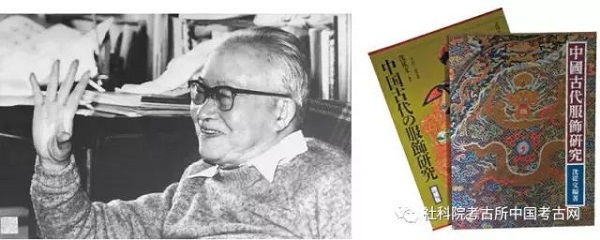
In 1963, during his diplomatic visit, Premier Zhou Enlai found that China, which is famous for its silk weaving, had completely lost its own textile and clothing language, which formed a huge contrast in international exchanges. Therefore, he entrusted Mr. Shen Congwen with the task of completing the gift book of "Research on Ancient Chinese Clothing", which clearly defined the world cultural status of China’s textile culture.

Shen Lao himself recalled the beginning of "Research on Ancient Chinese Costume": "In the early spring and summer of 1960s, Premier Zhou Enlai and people from several cultural departments talked about going abroad every time, and they were often invited to visit clothing museums and wax museums in those countries, because they could represent the cultural development and technological level of this country. Generally speaking, their exhibitions are mostly materials from the Middle Ages to the 17th and 18th centuries. China has a long history and culture, and there are a lot of old and new materials. I wonder if it is possible to systematically compile some of these books and give them away as cultural gifts when going abroad in the future. At that time, Mr. Qi Yanming was the Deputy Minister of Culture, and I recommended it. "

Mr. Shen Congwen and A Study of Chinese Ancient Costume

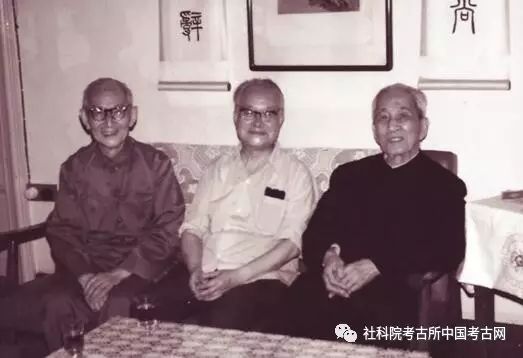
After the turmoil in the 1960s and 1970s, until September 1981, the Chinese and Japanese versions of Research on Ancient Chinese Costume were finally published by the Hong Kong Branch of the Commercial Press, which was the pioneering work of the research on ancient Chinese Costume. At that time, Mr. Shen led Mr. Wang and I to proofread the manuscript in the office of Hong Kong Commercial Press. During this period, Mr. Shen Congwen also took time to visit his old friends Shang Chengzuo and Mr. Rong Geng at Sun Yat-sen University. At that time, the joyful scene of three wise men was very touching. On that day, Mr. Shang also wrote the title of the book "Research on Ancient Chinese Costume".

Mr. Shen Congwen (middle) and Mr. Rong Geng (right) and Shang Chengzuo (left)

(2) Get to know Mr. Shen Congwen

Mr. Shen Congwen’s interest in the study of cultural relics and historical materials began very early. From the 1930s, he paid special attention to various crafts in his hometown Miaoxiang, Xiangxi, and began to write some papers on textile archaeology in the 1940s. After liberation, because of the need of job change, he devoted himself to the research and preaching of cultural relics. Premier Zhou’s entrustment became an opportunity for Mr. Shen to devote more of his mind to the research work of "mutual proof of history and reality" in textile and apparel. For example, in 1953, Mr. Shen published an article on "Weaving Gold Brocade" in "New Observation", with more than 10,000 words, in which he put forward many new ideas that others did not pay attention to at that time. Among them, the naming and naming of many things was decided by Mr. Shen. For example, the concept of "jade clothes" that we are familiar with now comes from this article. Sure enough, the tomb of Liu Sheng, the king of Zhongshan Jing, and his wife Dou Wan in Mancheng, Hebei Province, which was excavated in 1968, has been unearthed, confirming Shen Lao’s inferential research.

As we all know, Mr. Shen Congwen’s research on ancient Chinese costumes encountered many problems and delayed a lot because of the times, but in the meantime, Shen Lao never stopped reading and pondering over documents and cultural relics. Mr. Wang and I got to know Mr. Shen in these turmoil and hardships, and were taught by him to invest in the research work of ancient Chinese costumes.

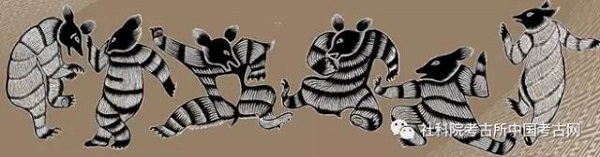
In the 1970s, the library was a deserted place, with only a few people all day. I got acquainted with Professor Yang Xianru, a good friend of Mr. Shen, from the Chinese Department of Renmin University of China, because I was looking for periodical materials in the Beijing Library. After knowing the information I was looking for, Professor Yang told Mr. Shen Congwen that I had the information I needed and warmly introduced me to Mr. Shen Congwen. In 1973, due to Mr. Shen’s lack of assistants, I hoped I could help him draw, so Mr. Shen asked me to "draw" the bear play of the five-bird play, which was advocated by Hua Tuo in the Western Han Dynasty, according to a group of pictures of gold and silver artifacts in People’s Pictorial. After reading it, Mr. Shen was very satisfied and thought that I understood his required intention. Since then, I have become a helper in the study of Mr. Shen’s material and cultural history.

Bear play of wuqinxi

In the 1970s, Mr. Shen continued to sort out the manuscript of "Research on Ancient Chinese Costume", and he never stopped studying various material and cultural history. But what Shen Lao is really most concerned about is how to spread the essence of national culture more, so from the beginning, his research method is "historical facts prove each other", and the goal is to make more people understand and narrow the distance with the essence of traditional culture through these studies after comparing the physical objects with the literature. Mr. Shen’s research has always been the pursuit of painting reproduction and physical evidence collection. My early work was also here. Since then, I have also entered the research of traditional textile and clothing culture until today.

(3) Initiating the cause of textile archaeology

In 1978, Mr. Shen was transferred to the Institute of History of China Academy of Social Sciences to establish a research room for ancient Chinese costumes. Proposed by Mr. Shen Congwen and approved by Dean Hu Qiaomu, Mr. Wang and I officially became Mr. Shen’s assistants, which initiated the study of textile archaeological cultural relics and advocated the materialistic method of "taking the history of physical evidence" to study clothing culture. Although Mr. Wang and I can’t compete with Mr. Shen, we did finish some work that Mr. Shen didn’t set foot in, which made the work of Mr. Shen in his later years smoother. The combination of our practice and Mr. Shen’s research benefited us greatly, which can be described as the great fortune of our generation.

When I assisted Mr. Shen’s clothing culture research in the early days, a series of work was initiated in China, which really improved the work content of China ancient textile clothing research, and I also engaged in clothing culture research all my life. This work is all the practice and research work of textile archaeology. It not only really perfects the research work of textile and clothing initiated by Mr. Shen, but also becomes the only China-specific branch of archaeology in China.

As the first practitioners of this work, I deeply felt the profound accumulation of ancient Chinese costume culture and history in practice, so I felt that my responsibility was great. As the staff at the archaeological site, they exercise the duty of protecting and studying cultural relics. The organic textile cultural relics that are difficult to be preserved are fragile and deteriorated. A slight mistake at the scene will destroy or mislead the direction of culture. It can be said that it is a big crime to see and not get them. More than forty years of first-line work experience, I dare not comment on others, but always introspect. In retrospect, I should have a clear conscience.

Mr. Wang and I participated in the excavation, protection and restoration of textiles, including Mawangdui Han Tomb in Changsha, Hunan Province, No.1 Chu Tomb in Jiangling Mashan, Jingzhou, Hubei Province, Tangta Palace in Famen Temple in Shaanxi Province, Liu Sheng Tomb in Zhongshan, Hebei Province, Dabaotai Han Tomb in Beijing and Guo Tomb in Sanmenxia, Henan Province. After Mr. Wang’s physical condition declined, I personally presided over the excavation, restoration, protection and research of many textile cultural relics, such as the Eastern Han Tomb in Niya, Minfeng, Xinjiang, the Han Tomb in Laoshan, Beijing, the Yuan Tomb in Yuanling, Hunan, the Tomb of Military Attaché in Shijingshan in Qing Dynasty, the Eastern Zhou Tomb in Jing ‘an, Jiangxi, the cultural relics in Ciyun Temple Tower in Ganzhou, Jiangxi, the cultural relics in Pigeon Cave in Longhua, Hebei, and the Liao Tomb in Yemaotai, Liaoning. These works gradually formed a relatively complete physical chain of textile cultural relics in China, which provided important evidence for the study of ancient Chinese costume culture, and also improved the protection of textile cultural relics and the research of technology in practice.

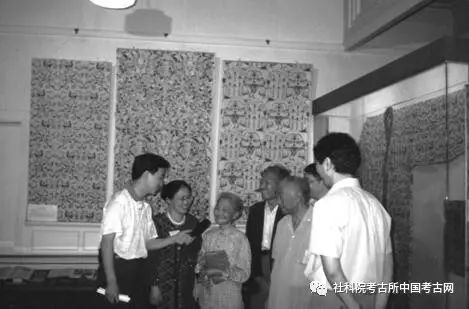
1995 is the 30th anniversary of Mr. Shen Congwen’s research on ancient Chinese costumes. With the support of Mr. Guo Hanying, the son of Guo Moruo, the Institute of History of China Academy of Social Sciences, a small commemorative exhibition was held in Guo Moruo’s former residence. The exhibition was very successful and won unanimous praise from leading experts from China Academy of Social Sciences, China Academy of Sciences, National Cultural Heritage Administration, Peking University, Tsinghua University and Beijing Institute of Fashion. At that time, Mr. Wang Renzhi, executive vice president of China Academy of Social Sciences, gave us eight words with great emotion after knowing our work situation in detail: hard work and bleak management.

Left one: Xinhua News Agency reporter, left two: Wang Yarong, left three: Mrs. Shen, right three: Wang, right two: Wang Zengqi, right one: Guo Hanying.

Second, the practice and research in the field of textile archaeology

Mr. Shen Congwen strongly advocated that the study of costume culture should make the past serve the present. Textile archaeological excavation and protection is to inherit the skills of China elements of our ancestors, and apply them to all aspects of modern social life. It is the closest research to modern social life to revitalize the study of China’s clothing culture and clothing. Therefore, under the guidance of Shen Lao, we pay special attention to the extension of textile and clothing research work. The following will give three examples to describe the situation of textile archaeological sites in recent years.

(1) Eastern Zhou Tomb in Jing ‘an, Jiangxi Province

Jing ‘an County, Jiangxi Province is located in Yichun City, northwest Jiangxi Province, 80 kilometers southeast of Nanchang. Jing ‘an County, Jiangxi Province has a high terrain in the west and a low terrain in the east, with mountains in the west and hilly plains in the east. The North River runs through the whole territory from west to east. Shuikou Township, where the Tomb of the Eastern Zhou Dynasty is located, is located ten kilometers west of the county seat, which is a transitional zone from hills to western mountains. Shuikou basin is about three kilometers long from east to west and two kilometers wide from north to south. The tombs of the Eastern Zhou Dynasty are located on the southern edge of the basin.

According to the relics collected from the Eastern Zhou Tomb in Jing ‘an, Jiangxi Province after being stolen, including silk fragments, National Cultural Heritage Administration approved the rescue excavation of the tomb, and informed me to participate in the rescue and protection of silk together with Jiangxi Institute of Cultural Relics and Archaeology. The tomb is a vertical hole tomb with earth pits, divided into three groups of 47 coffins, and there is almost no gap between coffins. Therefore, the primary problem faced by archaeological work is how to extract the coffin. Because the water level in the south is low and humid, and there is a lot of water in the coffin, siphon pumping is adopted. In order to prevent the silk in the coffin from being bumped and dislocated during transportation, it is coated with desized white cotton cloth. Then, we made a special iron carriage, transported the coffin to a large grain depot nearby for cleaning and disinfection as a temporary laboratory, and cooled the room temperature to 18℃ with ten air conditioners.

Eastern Zhou Tomb in Jing ‘an, Jiangxi Province

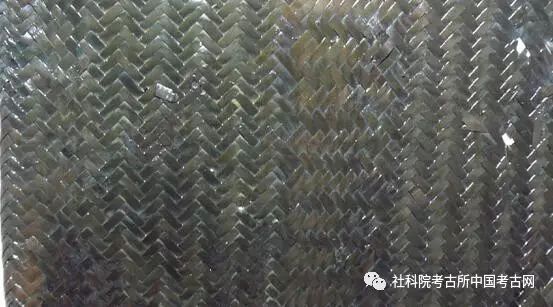
Because the bamboo mat wrapped the corpse is very fragile, the method of coiling was adopted, and at the same time, attention should be paid to water conservation. After extraction, it was found that the weaving technology of bamboo mats at that time was almost the same as that of modern times, and they were all "human" patterns.

Excavate the cleared bamboo mat.

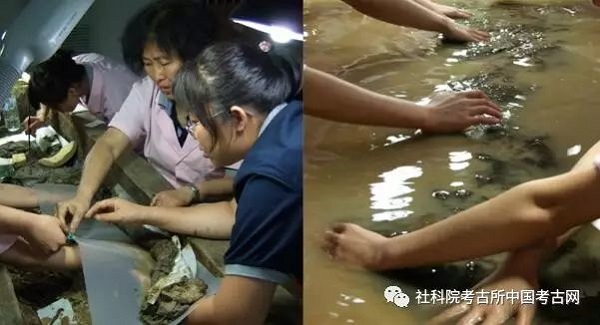
In the process of cleaning silk fabrics, it was found that mud, sand and silk fabrics were mixed together, and those sands were very small, the largest of which was only the size of mung beans, so they were picked up one by one. Silk fabrics are also wrapped in soil, so it is impossible to judge the specific shape and appearance. Therefore, we decided to build a pool beside it, beat the water with our hands, and use the ripples of the water to swing out the mud. Every time we clean it, we need to change the water for 50 or 60 times. When the silk fabric is about to be cleaned, we need to slowly absorb the water and mud with a sponge. This process is very long. When the mud was completely cleaned up, the largest piece of textile unearthed from the coffin so far was obtained, and it was determined that the silk fabric was a square hole yarn of mulberry silk.

Excavation of the Eastern Zhou Tomb in Jing ‘an, Jiangxi Province-Pick-up and Cleaning of Textiles

The Eastern Zhou Tomb in Jing ‘an, Jiangxi Province, after two years of on-site rescue cleaning and protection, the earliest warp and brocade textiles in China have been discovered so far (most of the textiles we see now are weft-knitted). In this tomb, the square hole yarn, hunting brocade and geometric brocade of silk fabrics from the Eastern Zhou Dynasty were cleared up, among which the density of geometric double-color brocade fabric reached 240×10 pieces/cm2, which is quite high today. After preliminary research, all the tomb owners are women aged 15 to 25, but no jewelry has been found, which may not be the wife and concubine of the dignitaries, but the weaver of the nearby textile workshop. This excavation work successfully rescued the tombs and precious cultural relics of the Eastern Zhou Dynasty under protection, and obtained many empirical evidences of the costume culture of the Eastern Zhou Dynasty. This tomb of the Eastern Zhou Dynasty was rated as one of the top ten archaeological discoveries in China in 2007.
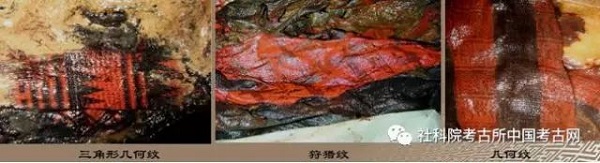
Original Jing Jin Unearthed from Eastern Zhou Tomb in Jing ‘an, Jiangxi Province

(2) Chu Tomb of Warring States Period No.1 in Mashan, Jiangling, Hubei.

Mashan No.1 Warring States Tomb in Jiangling, Hubei Province, which was cleaned in 1982, was in good sealing condition. Silk cultural relics were well preserved in the coffin. It was amazing at the beginning of the coffin opening, and it was very beautiful to see colorful embroidered quilts. But after a glance, Mr. Wang decided to immediately close the coffin and seal it and transport it back to the laboratory for further cleaning, so as to clean, protect and study it in a better environment. 

It has been more than 30 years since the excavation of the tomb. Except for the excavation personnel, the cultural relics that people can see are all exhibits or pictures after excavation, and most people’s understanding of cultural relics is "second-hand" or incomplete. Mashan N10 (the tenth cultural relic of the inner coffin) has a scarf tapestry with a light yellow silk face tattooed by a phoenix flower. Most of the cultural relics can only see a positive image, and if we only take the picture data as the basis, we may get two restoration results. What is really noteworthy is that these two results seem to be consistent with the report in terms of patterns, colors, sizes, etc., so which is true or false? We then studied the back of two kinds of restored products, and finally confirmed the results according to the specific process techniques.

N10 phoenix bird flower tattooed on the No.1 Chu Tomb in Mashan, Jiangling (left: original copy, right: original copy)

It is worth paying attention to the collar of the cotton robe with light yellow silk face tattooed by the flowers of N10 phoenix bird at No.1 Chu Tomb in Mashan, Jiangling. The collar is a very regular geometric pattern, all of which are diamonds, while the pattern in the middle of the diamond is very elegant. For example, there is a carriage in the design, and the driver in blue is responsible for driving the carriage, and the yellow one is shooting an arrow with a bow and a standard behind it. Below the figure is a carriage, below which are wheels, and in front of which are galloping horses pulling carts. In the diamond on the right left of this set of hunting maps of horses and chariots, there is a beast with an arrow falling to the ground and looking back, and there is a running deer in front of the beast. In the diamond on the lower left of the hunting map of horses and chariots, there is a man twisting his body, holding a sword in his right hand and a shield in his left hand to fight the tiger opposite. In the diamond on the right side of the pattern, there is a man kneeling on the ground, fighting with a leopard with a dagger in his right hand, and there is a small hunting dog next to him. In this unit, which is only 6.8 cm wide and 17 cm long, the scene of ancient nobles shooting rich wolves and fighting tigers and leopards is shown. Only this deputy collar, an embroiderer needs to embroider for more than seven months, which shows the luxury of the king’s life at that time.
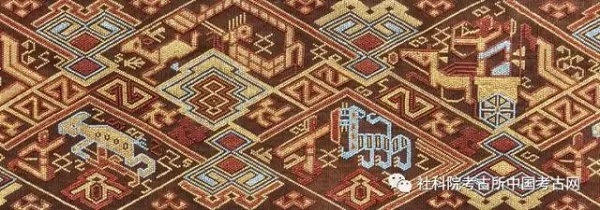
The hunting map of horses and chariots on the collar

Perhaps the above examples should make everyone feel that the real history of textile cultural relics is sometimes misunderstood blindly. Mashan Chu Tomb is the precious silk products of the Warring States period that we first saw and cleaned up. As practitioners who stripped, protected and recorded textiles, the seriousness and rigor of our work was obvious to all at that time. Even so, the understanding of the tapestry was not correct at the initial stage, and even the excavation report was mistakenly written as a tapestry.

There are also mistakes in many published materials, such as the unit pattern extraction of embroidered quilt in Mashan Chu Tomb. Except for the Study of Ancient Chinese Costume by Mr. Shen Congwen, even the Excavation Report of No.1 Chu Tomb in Mashan, Jiangling, Hubei Province by Cultural Relics Publishing House has deviations in the division of pattern units. This may also be related to the misunderstanding of cultural relics as the digger himself. The correction of these misunderstandings comes from Mr. Shen’s long-standing research requirements and his strong desire to reproduce historical truth.

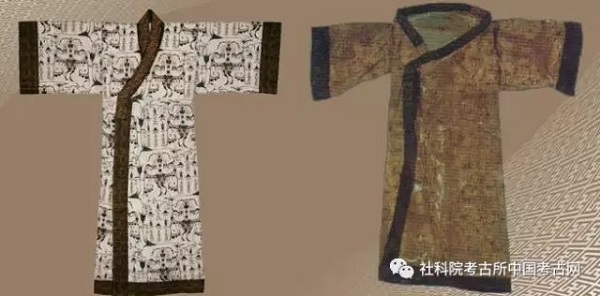
In the 1970s, after completing the excavation of the Chu Tomb in Mashan, Jiangling, Hubei Province, I personally devoted myself to the vision of the reappearance of cultural relics after work. Under the extreme enthusiasm for the appearance of cultural relics more than 2,000 years ago, we overcame many difficulties, made a deeper interpretation of cultural relics again, and set out to copy the N10 robe of Mashan No.1 Chu Tomb. The robe has straight sleeves, wide cuffs and a right collar. The dress is complete with lock embroidery to complete the embroidery of phoenix flower pattern, and the collar edge field hunting tattoo decoration is completed with nano-embroidery technology. China’s traditional clothing with plane cutting has always had the effect of three-dimensional cutting, but at first glance, N10′ s underarm square insert did not know its function. However, after the recovery, wearing a belt, no matter what action the hand makes, the dress will not move, which is not only convenient for the action, but also maintains the etiquette of Jing Ya, which is worth learning from today.
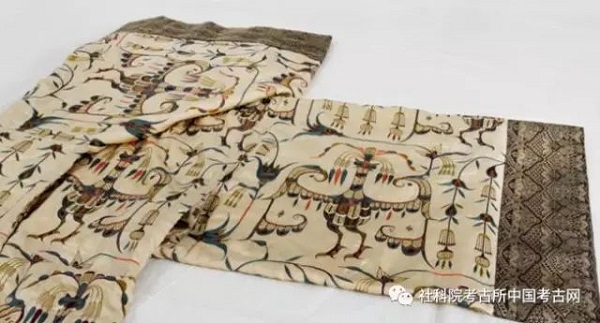
N10 garment replica of Mashan No.1 Chu Tomb

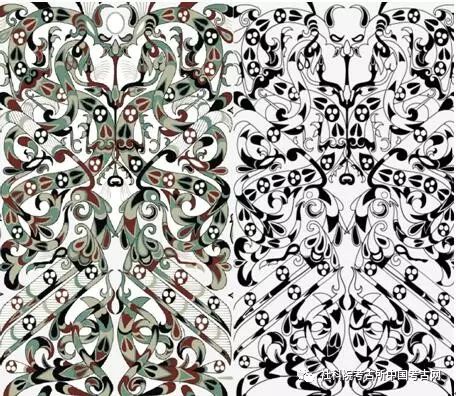
The pattern on N2 quilt of Mashan Chu Tomb is also very beautiful. For example, in the dragon and phoenix combination pattern, two S-shaped dragons are opposite, and the wind mouth holds the dragon’s tail, which makes the dragons seem to be struggling. In this batch of decorative patterns, the phoenix is at the top, either biting the dragon’s tail with its beak or stepping on the dragon with its foot. The whole pattern structure is very particular about dragons and phoenixes crisscrossing each other, turning left and right symmetrically, and staggered up and down by half a grid. All the patterns in the tomb are mainly dragons, phoenixes and tigers, and the phoenix has the upper hand, which seems to be related to the totem or belief of the Chu nationality at that time.

The dragon and phoenix combination pattern on the quilt of N2 in Mashan Chu Tomb

Mr. Shen was very pleased with the reproduction of the textile cultural relics of Mashan Chu Tomb. He even said that "the representative clothes that have been experienced for many years will be made one by one and displayed in a room, which is the China Costume Museum". Professor Zhang Guangzhi of Harvard pointed out with excitement: Your work is the reappearance of ancient costumes by using experimental archaeology research methods, which makes the latest research method that rose in the United States unexpectedly appear in China and try it in textile archaeology, a new discipline that has not been paid enough attention to. He encouraged me to keep going.

Since the successful excavation and publication of the cultural relics of Mawangdui Han Tomb in Hunan Province, important textile cultural relics have appeared in a series of tombs such as Mashan Chu Tomb in Jiangling, Hubei Province, Tangta Palace in Famen Temple in Shaanxi Province, Liu Sheng Tomb in Mancheng, Hebei Province, Dabaotai Han Tomb in Beijing, Yemaotai Liao Tomb in Liaoning Province, Guo Tomb in Sanmenxia, Henan Province, Niya East Han Tomb in Minfeng, Xinjiang, Laoshan Han Tomb in Beijing, and Dong Zhou Tomb in Jing ‘an, Jiangxi Province. Although we worked patiently, the method was not really taken seriously by the academic circles, and what remained was only the rotten and unrecognizable remains, which failed to make people intuitively understand silk cultural relics and left the world’s understanding of China’s silk weaving and clothing history in a gloomy impression. Although I feel deeply sorry and responsible, the busy work and limited funds have made the expansion of textile experimental archaeology expected by the old gentlemen come to a standstill.

(3) Hidden niche of Pagoda Temple of Ciyun Temple in Ganzhou, Jiangxi Province

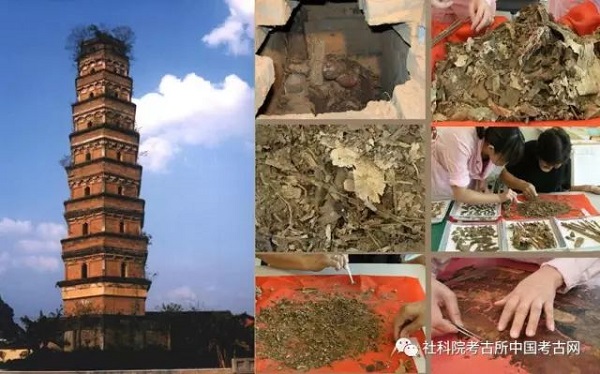
May 26th, 2004. Ganzhou Museum in Jiangxi Province has been repairing the stupa of Ciyun Temple, and found a large number of broken cultural relics in the early years of the Northern Song Dynasty in the hidden niche on the fourth floor of the inner wall.

Ciyun Temple Tower in Ganzhou, Jiangxi Province and Unearthed Cultural Relics Fragments

The restoration of paper-based paintings and calligraphy unearthed from Ciyun Temple Tower is quite different from the traditional mounting and restoration technology of China paintings and calligraphy. It is a restoration and research work jointly completed by archaeological taxonomy, cultural relics protection technology and China painting research, which took five years to complete.

In the early stage of debris sorting, many pieces were sorted for the first time according to basic characteristics such as material and color by using the method of shape classification in archaeology. Then these sorted pieces of paper and silk cultural relics are selected and classified according to their artistic meaning, and the pieces are reassembled and selected with similar artistic meaning and gradually put together. After the initial splicing, more than 30 paintings of support in the Northern Song Dynasty were repaired by connecting and shaping with a single silk screen of silkworm, exposing the life paper after painting the heart is stuffy, absorbing water and discharging solid with the lining paper, scraping the damaged part along the edge of the defect, mending according to the contour of the defect, sticking the folding strips and other steps, and there were almost no such paintings handed down at that time. At that time, Mr. Su Bai, a famous archaeologist, shook his head and said, "I don’t understand, I don’t understand", and suggested that no experts should write conclusive opinions, and the archaeological report should publish the information completely, so that experts from various related fields can participate in the research.
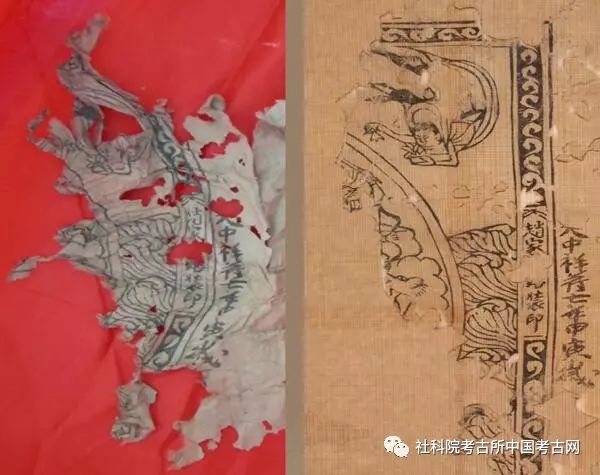
Before and after the restoration of the seven-year remnant of Dazhong Xiangfu

Third, the idea of establishing China Costume Museum.

Archaeological discoveries and documents in China record that Chinese’s clothing culture has evolved from the beginning to the world’s glory, and more than half a century’s scientific exploration of textile archaeology has also presented the world with a physical chain of clothing culture. From the ultra-fine bone needle of Xiaogushan discovered in Liaoning about 45,000 years ago to the textile machinery of Hemudu, to Mashan, Mawangdui, Famen Temple and Niya textile cultural relics, it eloquently shows the glory of China’s costume culture history. China’s sericulture and silk weaving technology is an important invention presented to the world.

Shen Congwen, a famous writer and cultural relic historian in China, was proposed by Premier Zhou Enlai half a century ago to create a precedent for the research and protection of China’s costume culture, and Shen Lao’s Study of Ancient Chinese Costume is a pioneering work in this field. Then, from Mawangdui Han Tomb, Mashan Chu Tomb, Famen Temple Underground Palace, Niya in Xinjiang, Laoshan in Beijing to Jing ‘an Tomb in Jiangxi, and so on, a series of major textile archaeological discoveries are amazing every time. In view of the limitation of fragile textile cultural relics preservation, Shen Congwen said to the embroidered cotton-padded clothes of the Warring States that we studied and copied: If we can do one thing when it is mature, every little makes a mickle, and it will be the "China Costume Museum" with a house on display. He also reported this idea to China Academy of Social Sciences and National Cultural Heritage Administration, but for various reasons, Shen Congwen and Mr. Wang failed to do so.

In the prosperous times, it will be a great event and a good deed to set up China Costume Museum. If people of insight unite with experts and scholars in the fields of archaeology, cultural preservation and textile, and combine with technical groups who have mastered traditional textile skills, on the basis of the research results and planning of the older generation of experts and scholars, and use the method of experimental archaeology to reproduce the true meaning of China’s costumes in a planned way, it should be the development direction and important measure of China’s costume culture to create a China costume museum integrating research, protection and inheritance.

China clothing museum should include the following functions:

1, textile archaeological excavation research and protection (to cooperate with qualified units), all kinds of textile processing technology research, protection and inheritance;

2. Holding an exhibition of textile archaeological discoveries;

3. Widely collect, protect and exhibit ancient textile cultural relics scattered in society;

4. On the basis of scientific research, high-level reproduction of fine clothing and cultural relics of past dynasties;

5, textile machinery (silk, twill, yee, brocade, velvet, satin, silk, makeup) into the display;

6. Printing and dyeing process (three series of plants, minerals and animals);

7. Silkworm reeling (simulated display);

8. Embroidery technology (process evolution and local characteristics);

9. Accessories (crown, boots and shoes, jewelry, quilt, accessories).

In a hurry for decades, Hua Fa is gray, recycled to the evening, and persisted with only a little persistence. Fortunately, I can say that I have a clear conscience about Mr. Shen. On the one hand, the research on China clothing initiated by Mr. Shen is advancing, and the spirit of Mr. Shen’s experimental archaeology has not been extinguished, and it is still quietly carried forward; On the other hand, through continuous efforts, Mr. Shen’s research has injected a lot of fresh blood and passed on in an orderly way. A young team of ancient textile protection research has basically matured and is growing day by day.

(Lecture draft finishing: Qin Chaochao)

In 2023, various natural disasters in China caused 95.444 million people to be affected, and the economic loss was 345.45 billion yuan.

  On January 20th, the National Disaster Prevention, Mitigation and Relief Committee Office and the Emergency Management Department released the basic situation of China’s national natural disasters in 2023 and the top ten natural disasters in 2023 after consultation and evaluation by the relevant member units.

  In 2023, floods, typhoons, earthquakes and geological disasters are the main natural disasters in China.

  In 2023, floods, typhoons, earthquakes and geological disasters are the main natural disasters in China, and droughts, wind and hail, low-temperature freezing and snow disasters, sandstorms and forest and grassland fires also occur to varying degrees. In the whole year, various natural disasters caused 95.444 million people to be affected to varying degrees, 691 people died and disappeared due to disasters, and 3.344 million people were resettled urgently; 209,000 houses collapsed, with 623,000 seriously damaged and 1.441 million generally damaged; The affected area of crops is 10539.3 thousand hectares; The direct economic loss was 345.45 billion yuan. Compared with the average value in the past five years, the number of people affected, the number of people missing due to disasters and the area affected by crops decreased by 24.4%, 2.8% and 37.2% respectively, while the number of houses collapsed and direct economic losses increased by 96.9% and 12.6% respectively.

  The main features of national natural disasters in 2023 are:

  one

  The distribution of natural disasters in China is uneven in time and space, and the pattern of "emphasizing the north and neglecting the south" is obvious.

  From January to March, except for the drought in southwest China in winter and spring and the major avalanche disaster in Linzhi, Xizang, the disaster situation in the whole country was relatively stable. In early summer, continuous rainy weather occurred in Henan and other places, which adversely affected the summer harvest. In the main flood season, super typhoon "Du Surui", catastrophic flood in Haihe River basin and severe rainstorm and flood in Songliao River basin occurred one after another. In mid-December, low-temperature rain, snow and freezing disasters occurred in Shanxi and other places, which had a great impact on people’s production and life. On December 18, the Jishishan earthquake in Gansu Province with a magnitude of 6.2 caused heavy casualties in Gansu and Qinghai provinces. The number of houses collapsed in the north and south accounted for 92.2% and 7.8% of the total losses in China, respectively, and the direct economic losses accounted for 73.7% and 26.3% respectively.

  2

  North China and Northeast China suffered from severe storms and floods, and local geological disasters of mountain torrents suddenly occurred.

  In 2023, the national average precipitation was 612.9 mm, 3.9% less than normal, and there were 35 regional rainstorms. From the end of May to the beginning of June, there was a large-scale continuous rainy weather in Henan, which overlapped with the mature harvest period of wheat, causing a large range of crops to be affected. During the "Seven Downs and Eight Ups" period, under the influence of the residual cloud system of Typhoon Du Surui, extreme rainstorms occurred in North China and Northeast China, and basin-wide floods occurred in Haihe River, causing heavy casualties and property losses in Beijing, Tianjin and Hebei, and serious flood disasters occurred in Songhua River basin, causing serious disasters in Heilongjiang and Jilin. The geological disasters of mountain torrents in the southwest and northwest are scattered at many points, with heavy casualties in Sichuan, Chongqing and Shaanxi. In the whole year, the flood disaster caused 52.789 million people to be affected to varying degrees, 309 people died and disappeared, 130,000 houses collapsed, and the direct economic loss was 244.57 billion yuan. In addition, there are 3666 geological disasters such as landslides, collapses and mudslides in China, and the disaster level is mainly small, mainly in North China and Southwest China.

  three

  The number of typhoons and landings is small, and the landing intensity is strong, which brings many extreme rainfalls.

  In 2023, there were 17 typhoons in the northwest Pacific and South China Sea, which were significantly less than normal, and 6 of them landed in China, which was slightly less than normal. Typhoon "Du Surui" brought heavy rain to Zhejiang and Fujian during its landing, causing local flash floods and waterlogging in some cities. After landing, the circulation was maintained on land for a long time, resulting in extremely heavy rainfall in North China, Huanghuai, Northeast China and other places, causing serious storms and floods; When Typhoon Sura landed, with the cooperation of cold air, it brought large-scale heavy rain to Guangdong and Guangxi. After the typhoon "Anemone" landed, the residual vortex affected South China for a long time, and the precipitation in Fujian and Guangdong exceeded the historical extreme. In 2023, typhoon disasters caused 11.316 million people to be affected to varying degrees, 12 people died and disappeared, more than 7,000 houses collapsed, and the direct economic loss was 47.49 billion yuan.

  four

  The moderate and strong earthquakes in mainland China are obviously weak, and the Jishishan earthquake in Gansu Province has caused great losses.

  In 2023, there were 11 earthquakes of magnitude 5.0 or above in mainland China, which was significantly lower than the average annual level over the years, including 2 earthquakes of magnitude 6.0 or above, which was also lower than the average annual level over the years. The 5.5-magnitude earthquake in Shandong Plain caused damage to more than 2,900 houses and some infrastructure, resulting in a direct economic loss of 240 million yuan. The Jishishan 6.2 earthquake in Gansu province caused 151 deaths, 983 injuries, 70,000 houses collapsed, 99,000 houses were seriously damaged, 252,000 houses were generally damaged, and the direct economic loss was 14.612 billion yuan.

  five

  Staged droughts have occurred in southwest, north and northwest, and the overall disaster situation is lighter than normal.

  In 2023, there were successive droughts in winter and spring in southwest China, summer drought in northern China and summer drought in northwest China, and the disaster situation was generally light. At the beginning of the year, there was less precipitation in most parts of southwest China, especially in Yunnan, where the average precipitation from January to May was 50% less than normal. From May to June, there are many high-temperature processes in North China and Huanghuai, which are extremely significant, and the precipitation in the northeast and west is 20-30% less. From June to August, precipitation and river inflow in western Inner Mongolia, Ningxia, most of Gansu and southern Qinghai are less, and there are temporary difficulties in drinking water for people and livestock and agricultural irrigation in some areas. In 2023, the drought disaster caused 20.974 million people to be affected to varying degrees, the affected area of crops was 38.037 thousand hectares, and the direct economic loss was 20.55 billion yuan.

  six

  Wind and hail disasters are scattered at many points, and Jiangsu and other places are affected by strong convective weather.

  In 2023, there were 33 strong convective weather processes in China, and the average value in the same period in the last five years was less, mainly in spring and summer. There are more than 1,100 counties (cities, districts) affected by wind and hail disasters in China, which are widely distributed in North China, Huanghuai, Northwest China and Southwest China. A total of 26 tornadoes were observed and recorded in the whole year, including 9 strong tornadoes, which was significantly higher than the average number for many years. Tornado disasters in Yancheng, Suqian, Nantong and other places in Jiangsu killed 14 people. In 2023, wind and hail disasters caused 6.053 million people to be affected to varying degrees, 57 people died, the affected area of crops was 11.745 thousand hectares, and the direct economic loss was 11.73 billion yuan. In addition, there were 17 sandstorms affecting China throughout the year.

  seven

  Northeast China and North China suffered from low-temperature freezing and snow disasters, and Linzhi, Xizang suffered a serious avalanche disaster

  In 2023, the whole country was affected by 31 cold air processes, including 8 cold wave processes. On November 5-7 and 21-24, the intensity of cold air reached a cold wave, and heavy snowfall occurred in Inner Mongolia and Northeast China. From December 13th to 16th, the intensity of cold air reached a strong cold wave, and the daily minimum temperature of 18 stations in Hebei, Shanxi, Beijing and Tianjin fell below the historical extreme value since the station was established in December, and there was a large range of rain and snow in the central region, which caused disasters in Hebei, Shanxi, Shandong and Henan. In addition, on January 17th, an avalanche occurred on Paimo Highway in Linzhi, Xizang, killing 28 people, making it the deadliest avalanche disaster in China in recent years. In 2023, low-temperature freezing and snowstorm caused 3.225 million people to be affected in different degrees, 30 people died, the affected area of crops was 5.192 thousand hectares, and the direct economic loss was 4.92 billion yuan.

  eight

  Forest and grassland fires started at several historical lows, and the situation was generally stable.

  In 2023, there were 328 forest fires in China, mainly in Inner Mongolia, Heilongjiang, Guangxi and Yunnan provinces (regions), and two people died as a result of the disaster. There were 15 grassland fires, mainly in Inner Mongolia, and one person died. The number of forest and grassland fires is at a historical low level, and the average number of forest and grassland fires has decreased by 77.5% and 46.8% respectively in recent five years.

  Top Ten Natural Disasters in China in 2023

  After consultation and evaluation by the relevant member units of the National Committee for Disaster Prevention, Mitigation and Relief, the top ten natural disasters in China in 2023 are as follows (in order of disaster occurrence time):

  one

  On January 17th, Xizang Linzhi Paimo Highway avalanche.

  At about 19: 50 on January 17th, an avalanche occurred at the exit of Duoxiongla Tunnel on the highway from Paizhen, Milin County, Linzhi City, Xizang (in the direction of Medog), and some vehicles and personnel were buried, resulting in 28 deaths.

  2

  Rainstorms, floods and geological disasters in Chongqing at the end of June and the beginning of July

  From the end of June to the beginning of July, some areas in Chongqing were hit by heavy rainfall, which caused floods and geological disasters, causing 358,000 people in 27 counties (districts) such as Wanzhou, Wushan, Wuxi, Shizhu and Qijiang to be affected to varying degrees, 25 people died and disappeared due to the disaster, and 18,000 people were urgently transferred and resettled; More than 600 houses collapsed, more than 700 houses were seriously damaged, and more than 1,800 houses were generally damaged; The affected area of crops is 22.8 thousand hectares; The direct economic loss was 1.31 billion yuan.

  three

  No.5 typhoon "Du Surui" in 2023

  The No.5 typhoon "Du Surui" in 2023 landed on the coast of Jinjiang, Fujian at around 9: 55 on July 28th, which was the strongest typhoon landing in Chinese mainland in 2023 and the second strongest typhoon landing in Fujian since 1949. There are 8-10 gusts in parts of eastern Fujian and eastern Zhejiang, and the local level is 11-16; The daily precipitation of five national meteorological observation stations in Quanzhou, Putian and Fuzhou in Fujian has exceeded the historical extreme. The typhoon caused 2.95 million people in Fujian, Zhejiang, Anhui, Jiangxi and Guangdong provinces to be affected to varying degrees, and 263,000 people were urgently transferred and resettled; More than 3,500 houses collapsed, more than 4,500 houses were seriously damaged, and 17,000 houses were generally damaged; The affected area of crops is 42 thousand hectares; The direct economic loss was 14.95 billion yuan.

  four

  Rainstorms and floods in Beijing, Tianjin and Hebei at the end of July and the beginning of August.

  At the end of July and the beginning of August, affected by the residual circulation of Typhoon Du Surui, Beijing-Tianjin-Hebei and other places suffered from extremely heavy rainfall, causing severe storms, floods, landslides, mudslides and other disasters, causing 5.512 million people in Beijing, Hebei and Tianjin to be affected to varying degrees, 107 people died and disappeared due to the disaster, and 1.434 million people were resettled; 104,000 houses collapsed, 459,000 houses were seriously damaged, and 775,000 houses were generally damaged; The affected area of crops is 416.1 thousand hectares; The direct economic loss was 165.79 billion yuan.

  five

  Rainstorm and flood disaster in Northeast China in early August

  At the beginning of August, affected by the superposition of typhoon residual cloud system northward and westerly trough, heavy rainfall occurred in many places in Northeast China, causing floods. Caused 1.194 million people in Heilongjiang and Jilin to be affected to varying degrees, 47 people died and disappeared due to the disaster, and 404,000 people were urgently transferred and resettled; 18,000 houses collapsed, 26,000 houses were seriously damaged, and 74,000 houses were generally damaged; The affected area of crops is 544.1 thousand hectares; The direct economic loss was 21.52 billion yuan.

  six

  "8.11" Mountain torrents and mudslides in Chang ‘an District, Xi ‘an, Shaanxi Province

  On August 11th, a sudden flash flood and debris flow disaster occurred in Jiwozi Formation, Wuziping Village, Luanzhen Street, Chang ‘an District, Xi ‘an City, Shaanxi Province, causing 27 deaths and missing.

  seven

  The "8.21" flash flood disaster in Jinyang, Sichuan.

  In the early morning of August 21st, Jinyang County, Liangshan Prefecture, Sichuan Province, was affected by short-term heavy rainfall, and a sudden flash flood and debris flow disaster destroyed the resident of the steel bar processing plant of the JN1 bid section project department of Yanjiang Expressway, causing 52 deaths and missing.

  eight

  Typhoon No.11 "Anemone" in 2023

  The 11th typhoon "Anemone" in 2023 landed on the coast of Dongshan County, Fujian Province and Raoping County, Guangdong Province at 5: 20 and 6: 45 on September 5. "Anemone" circulation and residual vortex have a long influence time. In Fujian, Guangdong, Guangxi, Jiangxi and other places, 17 stations have exceeded the historical extreme value in September, and 6 stations have exceeded the historical extreme value. Urban and rural waterlogging and geological disasters have occurred in many places in Fujian and Guangdong, and over 70 small and medium-sized rivers have been flooded, and over-protected floods have occurred in Mulan and Lanxi, Fujian. The typhoon disaster caused 3.12 million people in Fujian, Jiangxi and Guangdong provinces to be affected to varying degrees, 6 people died and 177,000 people were resettled. More than 2,600 houses collapsed, nearly 2,300 houses were seriously damaged, and more than 5,000 houses were generally damaged; The affected area of crops is 66.5 thousand hectares; The direct economic loss was 16.66 billion yuan.

  nine

  Wind and hail disasters in Yancheng, Jiangsu Province in mid-September

  From September 19 to 20, strong convective weather occurred in Yancheng and Suqian, Jiangsu Province, and local tornadoes caused wind and hail disasters. The disaster caused 20,000 people to be affected to varying degrees, and 10 people died due to the disaster. More than 500 houses collapsed, more than 1,600 houses were seriously damaged and 12,000 houses were generally damaged; The affected area of crops is 1.2 thousand hectares; The direct economic loss was 480 million yuan.

  10

  Jishishan M6.2 Earthquake in Gansu Province

  At 23: 59 on December 18th, an earthquake of magnitude 6.2 occurred in Jishishan County, Linxia, Gansu Province, with a focal depth of 10 kilometers, causing 772,000 people in Gansu and Qinghai provinces to be affected to varying degrees, with 151 people killed and 983 injured. 70,000 houses collapsed, 99,000 houses were seriously damaged, and 252,000 houses were generally damaged; The direct economic loss was 14.612 billion yuan.

  (CCTV reporter Zhao Yuxi)

Grasping the general trend of economic and social development from the strategic favorable conditions (rational view of economic situation)

  Core reading

  Understanding and grasping the internal logic of the five strategic advantages will help us to make full use of the strategic advantages, effectively deal with difficulties and challenges, keep the economy running in a reasonable range, and achieve the set goals.

  During the two sessions of the National People’s Congress this year, the General Secretary of the Supreme Leader profoundly expounded the strategic advantages of China’s development from five aspects: the strong leadership of the Communist Party of China (CPC), the remarkable advantages of the Socialism with Chinese characteristics system, the solid foundation for sustained and rapid development and accumulation, the long-term stable social environment, and the spiritual strength of self-confidence. It is of great significance to deeply understand and grasp the historical logic, theoretical logic and realistic logic contained in these five strategic advantages for us to effectively deal with the difficulties and challenges faced by current economic development under the background of the interwoven changes in the past century and the epidemic situation in the century, and for comprehensively promoting socialist modernization and smoothly realizing the great rejuvenation of the Chinese nation.

  On strategic advantages from the perspective of historical logic

  From the historical logic, five strategic advantages were created and established by the Communist Party of China (CPC) in the historical process of realizing the great rejuvenation of the Chinese nation.

  The Communist Party of China (CPC)’s leading position is the choice of history and people. Since its establishment, the Communist Party of China (CPC) has always regarded seeking happiness for the people of China and rejuvenation for the Chinese nation as its initial heart and mission, united and led the people to create great achievements in the new-democratic revolution, socialist revolution and construction, reform, opening up and socialist modernization, Socialism with Chinese characteristics in the new era and pushed the great rejuvenation of the Chinese nation into an irreversible historical process. History has fully proved that without the Communist Party of China (CPC), there would be no new China and no great rejuvenation of the Chinese nation. The Communist Party of China (CPC)’s strong leadership has provided a fundamental guarantee for us to calmly deal with various major risk challenges.

  Socialism with Chinese characteristics system is a scientific system formed by the party uniting and leading the people in long-term practice and exploration. After the founding of New China, the Party United and led the people to complete the socialist revolution, eliminated all exploitation systems, and achieved the most extensive and profound social changes in the history of the Chinese nation. Entering the new era of reform, opening up and socialist modernization, the Party has resolutely promoted the reform of economic system, at the same time, carried out institutional and institutional reforms in political, cultural and social fields, pushed forward the new great project of Party building, successfully created Socialism with Chinese characteristics, and constantly adhered to and developed the vibrant Socialism with Chinese characteristics system in line with contemporary China’s national conditions. Since the 18th National Congress of the Communist Party of China, the CPC Central Committee with the Supreme Leader as the core has focused on the long-term governance of the Party and the long-term stability of the country, and made an overall plan to uphold and improve the Socialism with Chinese characteristics system, promote the modernization of the national governance system and governance capacity, promote the maturity and finalization of the Socialism with Chinese characteristics system, further consolidate and highlight its institutional advantages, and provide a fundamental guarantee for us to resist risk challenges and improve the efficiency of national governance.

  Under the strong leadership of the Communist Party of China (CPC) and the strong guarantee of the Socialism with Chinese characteristics system, the party leaders have completed the industrialization process that developed countries have gone through for hundreds of years in just a few decades, creating a miracle of rapid economic development and long-term social stability that is rare in the world. China’s economic strength, scientific and technological strength, national defense strength and comprehensive national strength have been significantly enhanced, and the foundation for realizing the great rejuvenation of the Chinese nation has become more solid; People’s sense of acquisition, happiness and security have been significantly enhanced, the level of social governance has been continuously improved, and society has remained stable for a long time; China people’s enthusiasm, initiative and creativity have been further stimulated, and their ambition, backbone and confidence have been unprecedentedly enhanced. The party’s heart, army’s heart and people’s hearts are high and inspiring, and their spiritual strength of self-confidence and self-improvement is growing stronger. All these provide us with strategic favorable conditions for coping with various risk challenges, promoting high-quality development and realizing the great rejuvenation of the Chinese nation.

  On strategic advantages from the perspective of theoretical logic

  From the perspective of theoretical logic, the five strategic advantages profoundly embody Marxist standpoints and methods, such as strategic thinking, systematic thinking, Marxist material view and the law of mutual change of quality.

  Reflects the strategic thinking. Strategic thinking is the overall and long-term thinking, the thinking mode of planning and guiding around the overall and long-term major issues, and the important embodiment of Marxist methodology in thinking mode. If a country wants to gain a firm foothold and seek development in the complicated international and domestic situation, it cannot do without strategic thinking. For China, a developing country with the largest population in the world, strategic thinking is even more indispensable. The five strategic advantages are that General Secretary of the Supreme Leader, starting from the overall situation of the cause of the party and the country, stands at the height of coordinating the overall situation of the great rejuvenation strategy of the Chinese nation and the unprecedented changes in the world in the past century, combines the basic principles of Marxism with the concrete reality of the new development stage, adheres to the problem orientation, respects the law of development, and uses strategic thinking to make an incisive summary of China’s overall, fundamental and long-term competitive advantages, which fully reflects our party’s adherence to and application of the basic methods of Marxism.

  It embodies systematic thinking. The five strategic advantages refine the strategic advantages of China’s development from multiple dimensions, such as leadership, institutional characteristics, material foundation, social environment and spiritual strength. They are the decoding of the miracle of China’s economic and social development from the perspective of strategic overall situation by using systematic thinking, and also profoundly reveal the root of our continuing to create new and greater miracles.

  It embodies the Marxist view of matter. Marxism holds that matter determines consciousness, and consciousness reacts on matter. Material determines consciousness, which requires us to insist on proceeding from reality and seeking truth from facts. The five strategic advantages are precisely the generalization and summary made from the reality of China’s economic and social development and seeking truth from facts. For example, the solid foundation accumulated by sustained and rapid development and the long-term stable social environment have enhanced the people’s spiritual strength of self-confidence, which in turn has promoted the accumulation of material foundation and the maintenance of a stable social environment.

  It embodies the law of mutual change of quality. Strategic advantages such as material foundation, social environment and spiritual strength are gradually accumulated and formed. With the continuous strengthening of the Party’s overall leadership and the improvement of the Socialism with Chinese characteristics system, the material foundation for China’s development has been continuously consolidated, the social environment has been stable for a long time, and spiritual strength has been continuously gathered. The overall, fundamental and long-term strength of China’s economic and social development has been continuously enhanced, which has pushed China’s development into a new stage, changed the main social contradictions, and entered an irreversible historical process to realize the great rejuvenation of the Chinese nation.

  On strategic advantages from realistic logic

  From the perspective of realistic logic, five strategic advantages are the obvious advantages of China’s development in the new era and new journey, and are also the important basis for our party to make a scientific judgment that China’s development is still in an important period of strategic opportunities, and overall opportunities outweigh challenges, which embodies our party’s deepening understanding of the laws of China’s economic and social development.

  The five strategic advantages are interdependent and dialectically unified, and converge into a powerful force to promote China’s economic and social development, which embodies Socialism with Chinese characteristics’s advantages in road, theory, system and culture, and provides an important source of strength for realizing the country’s prosperity, national rejuvenation and people’s happiness. The party’s strong leadership grasps the direction of progress and condenses the great strength of endeavor; The remarkable advantages of Socialism with Chinese characteristics system guarantee development and progress; The solid foundation of sustained and rapid development has created favorable conditions for high-quality development; Long-term and stable social environment ensures development safety; The spiritual strength of self-confidence and self-improvement strengthens the confidence to move forward. It is precisely because of these five strategic advantages that we will be able to cope with the severe impact of the COVID-19 epidemic in 2020 and become the only country among major economies to achieve positive economic growth; In the case of frequent domestic epidemics this year and drastic fluctuations in commodity prices caused by the Ukrainian crisis, the economy started smoothly in the first quarter and prices and employment remained basically stable. Five strategic advantages not only provide a solid foundation for us to create and seize development opportunities, but also enhance our confidence and strength in coping with various risk challenges.

  Make full use of strategic advantages

  At present, major new changes have taken place in the international situation, and the task of domestic reform, development and stability is arduous and arduous. In this context, a deep understanding and grasp of the internal logic of the five strategic advantages will help us to make full use of the strategic advantages, effectively deal with difficulties and challenges, keep the economy running in a reasonable range, and achieve the set goals.

  Strengthen the overall leadership of the Party and uphold and improve the Socialism with Chinese characteristics system. The party’s leadership is the fundamental guarantee for doing well the work of the party and the country, and it is also the fundamental political guarantee for calmly coping with various major risks and challenges. Socialism with Chinese characteristics system is an advanced system with distinctive China characteristics, obvious institutional advantages and strong self-improvement ability, and it is the core password of "the rule of China". We should strengthen the Party’s overall leadership, adhere to and improve the Socialism with Chinese characteristics system, accelerate the modernization of the national governance system and governance capacity, and better transform the Party’s overall leadership and the remarkable advantages of the Socialism with Chinese characteristics system into governance efficiency and a powerful supporting force to cope with the downward pressure on the economy and maintain macroeconomic stability.

  Grasp the historical initiative and take the road of China. Socialism with Chinese characteristics Road is a broad road to create a better life for the people and realize the great rejuvenation of the Chinese nation, but the road ahead cannot be smooth sailing. In the face of all kinds of complicated situations and risk challenges, we must hold our destiny in our own hands, and we must be firm and determined to remain unchanged. We should strengthen Socialism with Chinese characteristics’s road confidence, theoretical confidence, institutional confidence and cultural confidence, constantly improve the development level of social productive forces and people’s living standards in China, and make Socialism with Chinese characteristics’s road wider and wider. Maintain strategic strength, not be afraid of any risks, not be confused by any interference, concentrate on doing your own thing well, strive to achieve the set goals with the persistence of insisting that Castle Peak will not relax, and unremittingly promote the great rejuvenation of the Chinese nation with the sober mind of those who walk a hundred miles.

  Combine the firmness of strategy with the flexibility of strategy. General Secretary of the Supreme Leader pointed out: "Strategy and strategy are dialectical and unified, and the firmness of strategy should be combined with the flexibility of strategy." Strategy is to make judgments and decisions from the overall situation, long-term and general trend. The right strategy needs the right strategy to implement. Strategy serves strategy under the guidance of strategy. The more complicated the situation is and the task is arduous, the more flexible it is to maintain the strategy, combine solving specific problems with solving deep-seated contradictions, and realize the dialectical unity of strategic firmness and strategic flexibility. Faced with the current downward pressure on the economy, we must firmly grasp the strategic choice of building a new development pattern to cope with the opportunities and challenges in the new development stage and implement the new development concept, unswervingly deepen the supply-side structural reform, accelerate the realization of high-level scientific and technological self-reliance and build a strong and resilient national economic circular system; It is also necessary to efficiently coordinate epidemic prevention and control and economic and social development, increase macro-policy adjustment, and solidly stabilize the economy.

  Five strategic advantages are an organic whole of dialectical unity. Among them, the Communist Party of China (CPC)’s strong leadership is at the core. Under the strong leadership of the Party, the remarkable advantages of Socialism with Chinese characteristics system have been brought into full play, China’s sustained and rapid development has accumulated a solid foundation, cultivated a long-term stable social environment, and condensed the spiritual strength of self-confidence, which in turn helps to further strengthen the overall leadership of the Party and promote the full play of Socialism with Chinese characteristics’s institutional advantages. Making good use of the five strategic advantages will surely enhance the strategic advantages of China’s development and push the Chinese nation towards a great rejuvenation at an unstoppable pace.

  (The authors are vice president of China Academy of Social Sciences and researcher of Economic Research Institute)

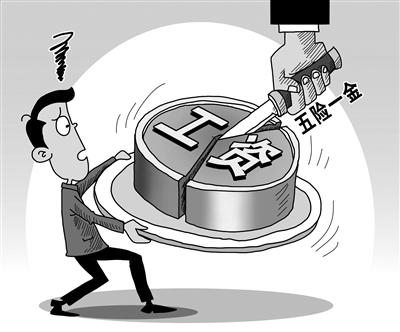
Five insurances and one gold account for nearly half of the total wages. Small and micro enterprises can’t afford to raise wages.

  Although the proportion of "five insurances and one gold" paid by all parts of China is not completely consistent, the proportion paid by most provinces and cities is above 40% of the total wages. Relevant data show that after comparing and analyzing the social security rates of 125 countries, only 11 countries have social security rates over 40%, and they are mainly developed welfare countries.

  Recently, Ma Kai, Vice Premier of the State Council, said that the current pension insurance payment level is on the high side, and "five insurances and one gold" has accounted for 40% to 50% of the total wages. Such a high payment ratio surprised many citizens: the original salary was less than 60% of the total salary. The destination of the remaining 40% difference has naturally become the object of attention of ordinary wage earners.

  fact

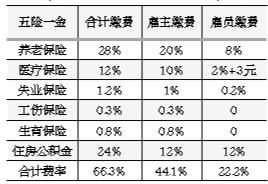
  The total deposit rate of five insurances and one gold in Beijing is 66.3%.

  "Five insurances and one gold" account for 40% to 50% of the total salary. What does this ratio mean? If you are a wage earner, if you work in Beijing, if your monthly salary (including tax) is 6,000 yuan, then your employer will have to pay 10,000 yuan or even 12,000 yuan in real money.

  The proportion of social security contributions exceeds 40%, which obviously surprises many wage earners. In fact, for many wage earners who have just entered the workplace, it is not clear what "five insurances and one gold" itself is. According to financial experts, the so-called social insurance "five insurances and one gold" specifically refers to five insurances: endowment insurance, medical insurance, unemployment insurance, industrial injury insurance and maternity insurance, and "one gold" housing provident fund. Among them, pension insurance, medical insurance and unemployment insurance are premiums paid jointly by enterprises and individuals, while industrial injury insurance and maternity insurance are entirely borne by enterprises, and individuals do not need to pay them.

  Another expert in the industry believes that the scope of social security should also include enterprise annuity. Enterprise annuity, also known as occupational annuity, enterprise pension or employer annuity, refers to a supplementary pension system that is established voluntarily by enterprises according to their own economic strength and situation, in addition to the public pension or national pension system enforced by the government, and provides a certain degree of retirement income protection for their employees. Dong Dengxin, director of Wuhan Social Security Society, said that in developed countries or mature markets, social security for the aged is only the bottom line, and the old-age security that really makes retirees feel safe needs to be supplemented. In foreign capital markets, the biggest contribution is enterprise annuity or occupational annuity rather than public pension. From a macro perspective, enterprise annuity is an indispensable and powerful supplement to social security.

  As the statutory social welfare of employees, how is the proportion of five insurances and one gold exceeding 40% of wages calculated? It is understood that the determination of social security contribution coefficient is different in different regions and different groups of people. According to the relevant regulations of Beijing, the three types of insurance, namely, endowment insurance, medical insurance and unemployment insurance, need to be paid by enterprises and individuals, and the proportions are endowment insurance: 20% for enterprises and 8% for individuals; Medical insurance: unit 10%, individual 2%+3 yuan; Unemployment insurance: 1% for units and 0.2% for individuals; Industrial injury insurance and maternity insurance are entirely borne by enterprises, and individuals do not need to pay. The proportions of the two types of insurance are 0.3% and 0.8% respectively. As for the housing provident fund, in 2014, the contribution ratio in Beijing was 12% for each enterprise.

  It can be seen that the above-mentioned five insurance and one gold enterprises account for 44.1%, individuals for 22.2%, and the total rate is 66.3%.

  analysis

  The actual expenditure of the enterprise with a salary of 10,000 yuan before tax is 14,410 yuan.

  Ma Jinghao, a visiting tutor and accounting expert at Central University of Finance and Economics, took the following case as an example to disassemble the composition details of social security five insurances and one gold. Suppose your pre-tax salary is 10,000 yuan. After deducting all kinds of social insurance and income tax, the monthly salary you can get is 7,454 yuan. The shrinkage of 25% is calculated as follows: for a salary of 10,000 yuan, individuals have to pay 8% of old-age insurance, 2% of medical insurance and 0.2% of unemployment insurance in 3 yuan, making a total of 22.2%, plus 3 yuan, that is, 2,223 yuan. After deducting the tax payment of 322.70 yuan, the remaining 7454.30 yuan.

  As for your enterprise, the proportion of payment is far more than that of employees. The pre-tax salary of 10,000 yuan, the social security that enterprises need to pay, including pension insurance 20%, medical insurance 10%, unemployment insurance 1%, work injury insurance 0.3%, maternity insurance 0.8% and housing accumulation fund 12%, totaling 44.1%. It can be seen that the amount of social security paid by enterprises is about 4410 yuan.

  On the whole, you got 7,454 yuan for the pre-tax salary of 10,000 yuan, the actual expenditure of the enterprise was 14,410 yuan, the amount of social security paid by the enterprise was about 4,410 yuan, and the individual paid 2,223 yuan, making a total of 6,633 yuan. Units and individuals paid a total of 6,633 yuan for five insurances and one gold, accounting for 89% of the after-tax salary of 7,454 yuan. The amount that enterprises need to bear is almost twice that of individuals. Ma Jinghao regrets that it is not easy to think of the actual expenses incurred by the enterprise for you when you get your salary.

  The employer paid 14,410 yuan per month, and the employee got 7,454.30 yuan. Where did the difference between 6955.70 yuan go? In this regard, Ma Jinghao explained with a chart, in which the three insurances paid by the unit were 3,210 yuan and the three insurances paid by the individual were 1,023 yuan, which were turned over to the social security agency; Units to pay, individuals to pay the provident fund of 1200 yuan each, turned over to the provident fund management institutions; Personal income tax of 322.70 shall be turned over to the tax authorities.

  discrepancy

  Most employees in small catering industry have no social security.

  Can all enterprises accept and practice such a high social security contribution ratio? Beijing Youth Daily recently interviewed a number of enterprises about their social security contributions. The results showed that not all enterprises in Beijing paid five insurances and one gold at the same rate of 44.1%, and different enterprises had different payment bases. For many small and micro enterprises, whether they are enterprises or employees, the reality is very skinny, and it is a problem to get five insurances and one gold or not.

  In a large joint-stock enterprise in Beijing, the reporter of Beiqing Daily got the payroll of a grass-roots employee, with a total salary of 4,860 yuan, deducted insurance premiums of 872.43 yuan, payable taxes of 14.63 yuan, and actually paid 3,972.94 yuan. The staff of the finance department explained that the above payroll actually cannot reflect the social security payment part of the enterprise and the specific contribution ratio of the individual. The payment base of social security is calculated from the average salary of the employee in the previous year. The details of the payment insurance provided in December 2014 showed that the payment ratio of five insurances and one gold was consistent with that stipulated by Beijing, and the total amount paid by enterprises was 44.1%.

  In another institution in Beijing, the social security personal payment information statement of an employee for four consecutive years from 2010 to 2013 shows that the column of "declared monthly payment salary" has basically shown an upward trend year by year, from 8585 yuan in 2010 to 9873 yuan in 2013. Its social security payment amount is also more than 1,000 yuan, of which the monthly unit payment is 1,974.60 yuan and the individual payment is 789.84 yuan for the pension in the first three months of 2014. From the perspective of payment ratio, the unit contribution ratio is 44.1%, and the individual contribution ratio is 22.2%+3 yuan.

  The reporter of Beiqing Daily consulted the staff of its human resources department and learned that the payment standard of five insurances and one gold was also "paid" based on the average monthly salary of the employee in the previous year. However, the staff explained that not all people use the average monthly salary of the previous year as the payment base. According to the regulations of the Beijing Social Security Bureau, the social security payment base in Beijing has an upper limit and a lower limit. In 2014, the upper limit of the social security base was 10% of the average monthly salary of Beijing employees of 5,793 yuan, which is 17,379 yuan. In other words, if the unit exceeds this amount, it will declare and pay social security according to 17379 yuan. The lower limit of social security base, the lower limit of pension and unemployment insurance is 2317 yuan, and the lower limit of other three insurances is 3476 yuan. If it is lower than this amount, social security will be paid according to 2317 yuan and 3476 yuan.

  The staff of the finance department of a small and medium-sized IT enterprise told the reporter of Beiqing Daily that the social security benefits of its employees are roughly calculated according to the minimum payment base stipulated by Beijing. This is the result of full communication with employees when they join the company. The reason is that the heavy burden of enterprises is part of it. For those employees born after 1980s or even 1990s, they are more concerned about their immediate salary, so they would rather give up the remote and invisible social security and convert part of the amount into the current salary.

  The boss of a small catering company bluntly said that most of the clerks in the small catering industry have no social security, except for large chains such as "Haidilao". The mobility of employees in this industry is too great, so it is unrealistic for both enterprises and employees to get social security. Some small catering enterprises will buy commercial insurance for their employees instead.

  Obviously, the embodiment of "social security" is different in different enterprises. Dong Dengxin once said in his certification of Weibo that providing enterprises with five insurances and two gold benefits can distinguish the labor grades in China. (1) Workers with at most five risks must work in small and medium-sized enterprises; (2) Workers who have complete five insurances and one gold must work in large enterprises or listed companies. This kind of employment is also called formal employment or decent work; (3) Workers with rich five insurances and two gold are mostly working in monopoly or profiteering industries.


A woman in Suzhou was sentenced for gambling in northern Myanmar 66 times in 4 years by smuggling and forging documents.

Little mongla in Myanmar, which is adjacent to Menghai County in Xishuangbanna Dai Autonomous Prefecture, Yunnan Province, is known as "Little Las Vegas" and has great attraction to gamblers.

On March 16th, the upstream journalist learned from the People’s Procuratorate of Wujiang District, Suzhou City, Jiangsu Province that recently, a woman in Suzhou City, Yu Mou, was sentenced for the crime of crossing the border illegally. From September 2016 to June 2020, the woman used forged documents, smuggling and other means to cross the border 66 times.

Yu has repeatedly crossed the border by smuggling. All the pictures in this article are upstream news pictures.

Yu, a 45-year-old woman, is a self-employed person in Wujiang. In 2015, when chatting with friends, Yu learned that there were many casinos in Xiaomengla, Myanmar. A friend suggested that you can fly from Shanghai or Hangzhou to the border between Yunnan and North Myanmar, and the other party will have a special person to pick up and drop off. After entering North Myanmar by crossing the border illegally, special people will be arranged to pick them up, and the round-trip air tickets are free.

Soon after, Yu Mou and his friends and a group of people took a variety of means of transportation, and arrived at Little mongla through the roundabout mountain road at the border of Daluo Town in Xishuangbanna.

Zhang Neng, deputy director of the First Procuratorial Department of Wujiang District Procuratorate, said that in 2016, Yu met his gambling friend Wang when he participated in gambling in Myanmar. Considering the risk of smuggling by mountain road, with Wang’s help, Yu defrauded the entry and exit permit to participate in gambling activities in northern Myanmar four times by fictional employee identity and related materials of a trading company in Xishuangbanna. Each pass is valid for one year.

For cross-border gambling, Yu forged his identity and defrauded the entry and exit pass.

"The so-called alternative planting project is actually because poppy was originally planted in Myanmar, and the local government encourages farmers or other relevant agricultural employees to stop planting opium and replace the project of planting other cash crops. In fact, Yu himself has no knowledge of this project and knows nothing about it. He completely forged such a reason and defrauded the entry and exit documents. " Zhang neng introduced.

Around the end of 2020, Suzhou police found the clue that Yu had stolen the country (border) during the investigation of entry-exit related work. After investigation, from September 2016 to June 2020, Yu Mou crossed the border between China and Myanmar from Daluo Port and Mangxin Port in Yunnan for a total of 66 times and went to Little mongla for gambling. Yu was sentenced to four months’ criminal detention and fined 3000 yuan for the crime of crossing the country (border).

Yu claimed to be engaged in the alternative planting industry, but actually he didn’t understand the industry.

Upstream journalists learned that in 2021, Wujiang District People’s Procuratorate handled 8 cases of crossing the country (border), and 29 suspects were all suspected of cross-border gambling. According to Yu’s confession, there are "gunmen" in the hotels where he lived during overseas gambling. At the same time, after the gambler lost all his funds, the criminals will take the opportunity to lend usury and drain the gamblers completely before calling his family. Ask for the so-called ransom.

"According to the parties concerned, after arriving in northern Myanmar, they were illegally detained by local illegal personnel and gangs, and some of them were still held in water dungeons. When he was rescued, the skin of his two calves had festered. If the police are not rescued in time, personal safety may not be guaranteed. " Zhang neng said.

Upstream journalists have learned that in many cases of cross-border gambling by sneaking across the country (border), criminals usually attract and attract domestic gamblers to gamble abroad by providing free entry and exit services, free round-trip air tickets, accommodation and tourism.

Zhang Neng introduced that many suspects who sneaked across the border to participate in cross-border gambling have a subjective misunderstanding. They think that it is not illegal to participate in gambling abroad. And no matter which way, as long as the entry and exit documents are handled, it is not an act of stealing across the country (border). From a legal point of view, defrauding entry and exit documents and holding such documents to enter or leave the country also constitutes the crime of stealing the border.

The MONA M03 in Tucki comes standard with a panoramic canopy with a visual area of 1.22㎡, which was launched in August.

On July 22nd, Xpeng Motors announced today that MONA M03 is equipped with panoramic canopy as standard, with a visual area of 1.22㎡.

According to the previous preheating information, MONA M03 in Tucki The whole system comes standard with 16GB of memory., equipped with a 15.6-inch central control large screen, with a high screen ratio of 88.5%, provides QQ music, Netease cloud music, Aauto Quicker, Mango TV, Youku video and other applications.

Tucki MONA M03 car positioning "A-class intelligent pure electric hatchback coupe",Pricing is within 200,000 yuan.Online booking has been started, and the first batch of five color schemes, including Xingyaolan and Xinghanmi, will be available in August.

According to the application list of the Ministry of Industry and Information Technology, there are at least two versions of MONA M03 in Tucki, and the IT House is summarized as follows:

The latest data of fuel consumption of the new Volkswagen LaVida quotation picture.

  During the mid-year impulse period, the Volkswagen LaVida plus in the 4S store has a maximum discount of 10,000 yuan. Now there are enough cars in the store and all colors are sold nationwide!

  Tips: Call the car hotline during the event to get (20,000) decorative gift packages sponsored by the manufacturer (foot pads, cushions, car refrigerators, driving recorders, film pasting, glaze sealing and plastic ……….). Considering the long distance for foreign customers to buy a car, our store can reimburse the one-way fare [train ticket, high-speed rail ticket and plane ticket (limited to two people)]. Welcome to our store to buy a car.

  SAIC Volkswagen Group Buying 4S Store Co., Ltd. Our insistence on perfect service — — Do well, professionally and continuously — — Specialization, speed and efficiency — — Enlarge, innovate and change — — To be stronger, we also adhere to the tenet of "honesty in operation, rationality in price, win-win cooperation and satisfaction in service". The company implements precise management, and the sales team is professionally trained to provide quality car purchase service and after-sales service based on the principle of honesty first and customer first. Welcome to our store for test drive consultation.

Sales hotline; 13366292719 Betty Wong

  The appearance of the new car has been changed. The current model has an angular design, and the front of the car has become more rounded from the previous 45. The big mouth shape conforms to the Chinese people’s cognition of "face", and the integrated layout of headlights can be seen on the upcoming new CC and Touareg. Different configuration models will be slightly different in detail design. Compared with the high-profile models, this 1.5L brand-new LaVida has reduced the chrome trim on the front air intake grille by half, so the front of the car will look thinner than the high-profile models.


Volkswagen LAVIDA


  The interior is still a simple style of the public, and try to add its own characteristics. For example, the gradual drawing style decorative board is a good attempt. With the shape of the center console shrinking to both sides, the overall interior style is much younger. And for the new LaVida, being practical is the key. The new LaVida adds four-way adjustment function to the steering wheel, and the whole system comes standard with electronic handbrake and AUTOHOLD function. The size of sunroof is increased, the size of multimedia screen is larger, and CarPlay mobile phone mapping function is equipped, which are all valued by consumers in China. In addition, the increase of ADAS system has also improved the active safety, which is also the future trend. From these aspects, the internal upgrade of the new LaVida is very successful.


Volkswagen LAVIDA


  In terms of power, the new generation LaVida is equipped with 1.4T turbocharged and 1.5L naturally aspirated engines, of which the maximum power of the 1.4T engine is 110kW(150Ps)/4800-5200rpm and the maximum torque is 250Nm/1750-3000rpm; The maximum power of 1.5L engine is 85kW(116Ps)/6000rpm, and the maximum torque is 150Nm/4000rpm. In terms of transmission, the 7-speed dual clutch, 5-speed manual and 6-speed automatic manual transmission are matched with the start.

  Business hours: Monday to Sunday (08:30— 17:30)

  1. The highest comprehensive discount during the activity.1-4 playYuan.

  2. The owner brings his ID card to the store to fill in the vehicle information, and foreign customers need to call the sales manager in advance to go through the formalities.

  3. Our company solemnly promises that during the activity, we can enjoy the lowest price in the country if we buy any models on sale, and make up the difference if we buy expensive ones.

  4. All models sold in our store are regular brand-new commercial vehicles. You can enjoy the national three guarantees policy. And can be free of charge in any regular 4S shop authorized by any manufacturer in the country for the first guarantee and subsequent maintenance.

  5. The company is now developing the foreign market in an all-round way, and the company can reimburse the travel expenses for the successful purchase of cars by foreign friends. (Reimbursement of one-way fare for two persons with valid bills)

  6. The company can issue all vehicle procedures on the day of car purchase.

  7. Foreign customers pick up their cars for free airport shuttle, so there is no need to worry about getting on the road.

  Handan tengyao automobile trading co., ltd

  Address: No.1 Fuqiang Road, Donghuan Road, Gaokai District, Handan, Hebei

  Tel: 1851527736

  The information content published by Che Xun Cheshangdao is released by the dealers themselves, and the authenticity and accuracy are the responsibility of the dealers, and Chexun.com does not assume legal responsibility.

The growth rate is accelerating quarter by quarter, and the structure is constantly optimized-China’s foreign trade shows a continuous improvement trend.

Since the beginning of this year, the global economic growth momentum has been weak. Faced with the unfavorable situation of the complexity, severity and uncertainty of the external environment, China’s foreign trade has run to a good "acceleration". The data shows that in the first half of the year, the total import and export value of China’s goods trade was 21.17 trillion yuan, a year-on-year increase of 6.1%.

Experts said that in the first half of the year, China’s foreign trade performed brilliantly, the trade scale reached a new high, and the high-quality development achieved remarkable results, showing resilience and vitality.

Foreign trade "report card" exceeds expectations

In the first half of the year, the scale of China’s foreign trade exceeded 21 trillion yuan for the first time in the same period, and the growth rate of import and export accelerated quarter by quarter, with an increase of 7.4% in the second quarter, which was 2.5 and 5.7 percentage points higher than that in the first quarter and the fourth quarter of last year respectively, and the positive momentum of foreign trade was further consolidated.

"In the first half of the year, the foreign trade’ transcripts’ exceeded expectations, and further optimization of export product structure is an important factor." Ni Yueju, a researcher at the Institute of World Economics and Politics of the Chinese Academy of Social Sciences, said.

In the first half of the year, China exported 7.14 trillion yuan of mechanical and electrical products, an increase of 8.2%, accounting for nearly 60% of China’s total export value. Externally, benefiting from the improvement of international market demand, some major economies have entered the replenishment cycle; Internally, a complete and resilient industrial chain supply chain provides a strong guarantee for the development of China’s electromechanical industry and the promotion of its international market share. In addition, the "new three kinds" continue to lead the growth of foreign trade, and the export momentum of high-end manufacturing products such as ships and marine engineering equipment and rail transit equipment is strong.

Foreign trade performance has a strong correlation with domestic economy. In the first half of the year, China’s economic operation was generally stable, with both quantitative growth and qualitative improvement, which laid a good foundation for foreign trade development. "The scale of foreign trade reached a record high, which also played an important supporting role in economic growth in the first half of the year." Zhu Caihua, a professor at the Institute of International Economics of the University of International Business and Economics, said.

Private enterprises have provoked the "beam" of foreign trade development, and their main position has become more stable. In the first half of the year, the import and export volume of private enterprises increased by 11.2%, accounting for 55% of the total import and export volume, an increase of 2.5 percentage points over the same period last year.

Zhao Tonglu, director of the National Economic Accounting Department of the National Bureau of Statistics, said that China has continued to promote high-level opening to the outside world, accelerated the cultivation of new kinetic energy of foreign trade, steadily increased the scale of foreign trade, and continuously optimized its structure, making positive contributions to promoting sustained economic recovery. In the first half of the year, the contribution rate of net exports of goods and services to economic growth was 13.9%, driving GDP growth by 0.7 percentage points.

Multi-strategy opens up growth space

In mid-July, Xi ‘an Customs and Qingdao Customs jointly launched the supervision mode of "direct sea-rail transportation by land and sea". After the inland goods arrive at Qingdao Port, they can be shipped directly, saving more than 24 hours for goods to be stored in the port and waiting for inspection and release at the port. Through innovative supervision mode, the customs of the two places have further improved transportation efficiency and enhanced the ability of foreign trade enterprises to expand the market.

Zhao Fujun, director and researcher of the Comprehensive Research Office of the Foreign Economic Research Department of the State Council Development Research Center, said that in the first half of the year, China’s imports and exports to countries that jointly built the "Belt and Road" increased by 7.2% year-on-year, which was 1.1 percentage points higher than the overall growth rate of China’s imports and exports; Imports and exports to ASEAN increased by 10.5%, which was also much higher than the overall growth rate of China’s exports. The cumulative number of trains in China and Europe exceeded 10,000 19 days earlier than the previous year, and the cumulative volume of goods sent increased by 11%, which played a positive role in maintaining the stability and smoothness of the international industrial chain supply chain.

With the steady progress of the high-quality development of the "Belt and Road", the economic and trade cooperation between China and the countries that jointly built the "Belt and Road" has continued to deepen. In the first half of the year, Fujian Province exported 64.82 billion yuan of cross-border e-commerce to countries that jointly built the Belt and Road Initiative, up 142.2% year-on-year, accounting for 58.6% of the total value of cross-border e-commerce exports in Fujian Province in the same period. Guangxi’s import and export to ASEAN, the largest trading partner, increased by 26.7% year-on-year, and its import and export ratio to ASEAN increased significantly, and its import and export to emerging markets increased rapidly.

In recent years, China’s foreign trade enterprises actively respond to changes in international demand, strive to cultivate new competitive advantages, and show strong resilience. However, due to the impact of the US dollar interest rate hike, weak export earnings and other factors, foreign exchange reserves in Africa and Latin America are generally insufficient, and it is difficult for Chinese foreign trade enterprises to repay their money on time after exporting to these regions. Zhao Fujun believes that in the future, BRICS expansion and "BRIC+"cooperation will provide more development opportunities for countries in the south of the world and will enhance their competitiveness in the global economy.

Foreign trade is expected to maintain steady growth.

In the second half of the year, the situation facing China’s foreign trade is still grim, but there are also many favorable factors. Experts believe that China’s foreign trade can still maintain a steady growth trend.

Under the background of increasing global trade protectionism, China’s trade will face some new situations in the second half of the year: unbalanced global economic recovery may lead to unstable demand; Geopolitical conflicts are becoming increasingly tense, which may produce unexpected situations to block the recovery process of international trade; Europe and the United States joined forces to suppress China’s new energy vehicles through high tariffs, which made the "new three" exports face new challenges.

Zhu Caihua believes that in the face of challenges, we should continue to accelerate the construction of a unified national market and continue to expand the scale advantage of the domestic market. Promote technological innovation and industrial transformation and upgrading, and constantly consolidate trade competitive advantages. Promote the transformation from "trade-oriented going to sea" to "ecological going to sea", that is, promote the transformation of some goods trade into investment and other cooperation modes, thus promoting the transformation of goods trade advantages into service trade and digital trade advantages. In addition, we should properly deal with trade barriers and trade frictions and accelerate the expansion of emerging markets.

We should also see that China’s foreign trade growth has many favorable factors. Ni Yueju said that China’s foreign trade has strong resilience, and a complete industrial chain and a series of foreign trade policies have also given strong support. It is expected that China’s foreign trade will maintain a steady growth trend in the second half of this year without sudden major international events.

Zhao Fujun said that the global trade situation this year is slightly better than last year. According to the report of the World Trade Organization, the global trade volume of goods decreased by 1.2% in 2023, and it is expected to increase by 2.6% in 2024. In addition, China’s domestic economic operation is generally stable, the RCEP tariff concession policy continues to release dividends, and the "One Belt, One Road" initiative is deepening, which is conducive to the steady development of China’s foreign trade. (Reporter Feng Qiyu)

The 2020 college entrance examination will end. Please keep this "post-exam reminder"!

  Beijing, July 10 (Reporter Zhang Ni) Today, the five provinces of Beijing, Tianjin, Zhejiang, Hainan and Shandong will end the final college entrance examination subjects, and the national college entrance examination in 2020 will officially come to an end. When will the exam results be announced? When do you fill in your volunteers? How to prevent fraudulent information from being recruited? Please keep this "post-exam reminder"!

  Part of the provincial college entrance examination time tabulator: Zhang Ni

  The 2020 national college entrance examination ended today, and the time for checking scores in more than 20 provinces has been made clear.

  On the 9th, the college entrance examination in most provinces in China has officially ended, and the five provinces of Beijing, Tianjin, Zhejiang, Hainan and Shandong will also end all the examinations on the 10th, which means that the national college entrance examination in 2020 will come to an end.

  By the evening of the 9th, at least 20 provinces including Beijing, Shanghai, Shandong, Hubei, Jilin, Qinghai, Hunan, Gansu, Chongqing, Jiangxi and Sichuan had announced the time of counting points, mainly from July 23rd to 26th.

  For example, the check time in Jiangxi, Guangxi, Hubei, Gansu, Sichuan, Inner Mongolia, Shanghai and other provinces is July 23rd. Qinghai, Beijing and Henan are July 25th; Jilin, Shandong and Tianjin are July 26th.

  In addition, some provinces give approximate time ranges. For example, Hunan’s results will be published before July 25th. The announcement time of Hebei and Yunnan provinces is around July 23; Fujian is around July 24th.

  After the results are announced, it is followed by volunteering, and the time varies from place to place.

  Beijing stipulates that from July 27 to July 31, candidates for the unified examination can fill in their undergraduate volunteers and start admission in early August.

  The time for candidates in Hunan to fill in their volunteers is: the undergraduate volunteers (including the national special plan of this batch) will be filled in from July 26th to 27th, and other volunteers will be filled in from July 26th to August 1st.

  Gansu college entrance examination volunteering is conducted twice. The first volunteering time is from 20:00 on July 25th to 20: 00 on July 27th. The second volunteering time is from 20:00 on September 4 to 14:00 on September 6.

  On July 8, at the test center of Pingtung Middle School in Fuzhou, Fujian, college entrance examination candidates walked out of the examination room easily after the exam. Photo by Lu Ming

  All localities should pay close attention to the recruitment discipline and guard against impersonation.

  In addition to test scores, this year, the deployment of recruitment discipline has attracted much attention.

  As early as before the college entrance examination, the Ministry of Education has clearly stated that it will intensify the supervision and inspection of illegal enrollment, and insist on finding, investigating and dealing with, and zero tolerance.

  The Ministry of Education emphasizes that it is necessary to seriously carry out the re-examination of freshmen’s admission, and resolutely cancel their admission qualifications and deal with them seriously for those freshmen who cheat, cheat in exams, defraud extra points or attempt to impersonate; Those who register for school will cancel their school status and will not be electronically registered as freshmen; At the same time, cooperate with public security, discipline inspection and supervision departments to find out the truth and investigate the responsibility of relevant personnel according to law and discipline.

  In addition, recently, the Ministry of Education announced the telephone numbers of the Ministry of Education and the education administrative departments and enrollment examination institutions of 31 provinces (autonomous regions and municipalities) in 2020. The Ministry of Education and all provinces (autonomous regions and municipalities) will work with relevant departments to check and deal with the clues as soon as possible, and resolutely safeguard the fairness and justice of the college entrance examination.

  At the local level, all localities have also included acts such as "impersonation" in this year’s crackdown blacklist.

  For example, Shandong has clearly emphasized that it is necessary to strengthen the management of examinations, admissions, enrollment and other links, and resolutely guard against impersonation in the college entrance examination; Guangdong has also made it clear that it is necessary to strictly check the student’s household registration and prevent the impersonation of college entrance examination immigrants.

  On the afternoon of July 8, at the test center of Xinmin Campus, Nanning No.2 Middle School, Guangxi, after the college entrance examination of English subjects, the teacher and the candidates took a group photo outside the examination room as a souvenir. China News Service reporter Chen Guanyan photo

  Curb the "Top Scholar in College Entrance Examination"fryThe wind of making

  In recent years, the education department has been curbing the hype of "the top student in the college entrance examination", and this year, all localities will strictly implement this policy.

  For example, as early as December 2019, 14 departments, including the Zhejiang Provincial Department of Education, jointly issued the Implementation Plan for Reducing the Burden of Primary and Secondary School Students in Zhejiang Province.

  The "Program" stipulates that parents are allowed to know the individual test scores and rankings of middle school students, and the school shall not publicly publish the test scores and rankings of students inside and outside the school in any way; It is not allowed to hold or disguise the swearing-in meeting of senior high school entrance examination and college entrance examination that excessively strengthens exam-oriented education. It is not allowed to publish or publish the "happy news" of senior high school entrance examination and college entrance examination in the name of family committees, and it is not allowed to advertise or disguise the "learning tyrants" and the "number one" of senior high school entrance examination and college entrance examination.

  In January this year, Henan Province issued the "Implementation Opinions on Promoting the Reform of Educational Methods in Ordinary High Schools in the New Era", demanding that the assessment and incentives for schools and teachers be improved, and it is strictly forbidden to speculate on the enrollment rate and the number one in the college entrance examination.

  In Anhui, in May this year, Anhui issued the "Action Plan for Deepening the Reform of Basic Education in Anhui Province and Improving the Quality of Educating People in an All-round Way", which clearly stated that it was necessary to change the educational concept, and it was strictly forbidden to speculate on the enrollment rate and the champion of the senior high school entrance examination and college entrance examination.

  On July 8, at a college entrance examination center in Hohhot, Inner Mongolia, candidates received flowers from their parents after finishing the exam. China News Service reporter Liu Wenhua photo

  Beware of these fraud traps!

  Every year in the college entrance examination, there are always some unscrupulous institutions or criminals who take advantage of the college entrance examination to find opportunities for fraud. In this regard, the public security organs have recently summed up some typical fraud traps to remind the majority of candidates and parents to beware of being fooled.

  Trap 1: Check the "phishing" website in the cottage.

  After the results of the college entrance examination were announced, some phishing websites disguised as the query interface of the college entrance examination results and promoted them on search engines and forums, thus invading computers and stealing candidates’ mobile phone numbers, ID numbers, bank card numbers and other information, and then stealing candidates’ online payment accounts to commit fraud.

  The police reminded: Candidates and parents must have a sense of authenticity when logging in to the college entrance examination and the websites of universities and education departments. When inquiring information, you should enter through the link certified by official website or the website officially released by the school and education department, and verify the authenticity of the account through various channels when transferring money and remittance.

  Trap 2: False information enrollment fraud

  The fraudster lied that he was an enrollment agent of a school or had a "special relationship" with university leaders, boasting that he could get "internal indicators" and ask for indicator fees. In this regard, the police suggested that it is now sunshine enrollment, and such scammers who lied that they can go to school by paying the money basically disappeared!

  Trap 3: Fraud by granting student subsidies

  The fraudster lied that he was from the education department, and he wanted to give several thousand yuan of student subsidies to poor college entrance examination students, and then tricked students or parents into operating in front of ATM machines by phone, and then transferred all the money in the card to implement fraud.

  In order to prevent scammers from taking advantage of the college entrance examination to get fraud opportunities, the police reminded the majority of candidates and parents to pay more attention to all kinds of college entrance examination information. Do not believe in fraudulent information such as "internal enrollment", "checking scores in advance" and "granting scholarships" sent by strangers; Don’t click on malicious links, and don’t easily choose to download unknown software and apps. (End)